

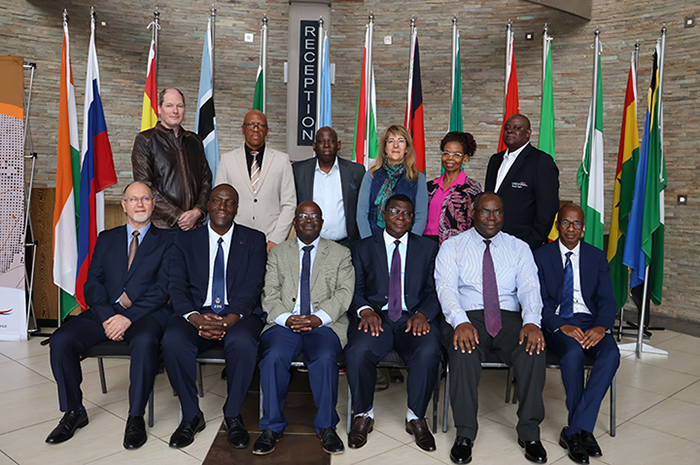
Members of the Unisa and ZOU delegations
Unisa’s Research, Postgraduate Studies, Innovation and Commercialisation (RPSIC) portfolio hosted delegates from the Zimbabwe Open University (ZOU) for a high-level engagement which took place from 16 to 18 March at the Muckleneuk Campus. The collaboration offered ZOU a comprehensive look into the processes and practices of RPSIC, a two-time Organisational Research Management Excellence Award winner.
Prof Les Labuschagne, Executive Director of Unisa’s Department of Research, Innovation and Commercialisation, expressed his satisfaction that the anticipated visit finally took place. He noted that the department had assembled a team to address the delegates’ areas of interest, with adjustments made to include additional domains.

Prof Les Labuschagne, Executive Director of Unisa’s Department of Research, Innovation and Commercialisation
For Labuschagne, it is difficult to separate the processes and practices without losing the context and understanding of how they work together, as each part plays an important role in terms of what they are trying to do. "The portfolio has a whole ecosystem that makes up our RPSIC environment," he said.
With the portfolio’s evolving nature, he emphasised the importance of both institutions using the visit as a two-way exchange.
Addressing delegates, Prof Mpho Ngoepe, Unisa Vice-Principal: Research, Postgraduate Studies, Innovation and Commercialisation, welcomed everyone present.

Prof Mpho Ngoepe, Unisa Vice-Principal: Research, Postgraduate Studies, Innovation and Commercialisation
Expanding the portfolio strategy, Ngoepe drew on the university’s strategic overview, which is shaped and informed by the Sustainable Development Goals (SDGs) at the global level, the Africa Agenda 2063 at the continental level, and the National Development Plan at the national level. Notably, an Annual Performance Plan (APP) was outlined to achieve a five-year goal with each portfolio contributing to this strategy.
He explained that the RPSIC portfolio drives Unisa’s efforts to advance research and innovation, one of the university’s five strategic pillars.
Proceeding further, he gave an overview of the five departments within the portfolio, namely the College of Graduate Studies, the Department of Research, Innovation and Commercialisation, Library and Information Services, Inhlanyelo Hub NPC, and Unisa Press.
"As much as we propel research and innovation, we are not the actual people who are doing research and innovation," he said. "We provide an enabling environment for the academics to excel in these two areas."
Additionally, he provided a summary of the key performance areas within RPSIC. In his presentation, he underscored his commitment to promoting open access to government-funded research and highlighted the global accessibility of Unisa’s research.
Presenting Unisa’s research outputs, Ngoepe emphasised the importance of maintaining both quantity in terms of publications and quality in terms of rankings. He also encouraged a shift towards digital systems to allow researchers to focus more on their work.
"Our aim is to participate in the Global Innovation Index in the long run," he concluded.
Prof Tavonga Njaya, ZOU’s Pro-Vice-Chancellor: Research, Innovation and Enterprise Development (RIED), expressed gratitude towards Unisa and the RPSIC portfolio for allowing the delegation to benchmark what the university does, especially concerning the government’s role in supporting research in an open and distance learning institution.

Prof Tavonga Njaya, ZOU Pro-Vice-Chancellor: Research, Innovation and Enterprise Development
Njaya outlined ZOU’s strategic plan for 2026-2030, which focuses on three programmes: Governance, Human Capital Development, and Research, Innovation and Industrialisation, under which RIED falls. RIED is responsible for increasing research and innovation and enhancing rural industrialisation through them. "For every innovation that you come up with, you have to ensure that a certain percentage is done in the rural areas to promote industrialisation in those areas," he said.
Njaya highlighted the impact of the Zimbabwean government’s introduction of Education 5.0 in 2018, which requires institutions to integrate innovation and industrialisation into their curriculum. As a result, several universities, including ZOU, have now formed private companies to complement their industry.
Presenting an overview of the RIED ecosystem, Njaya further highlighted that the establishment of new offices within their department has sparked interest in understanding how Unisa manages and commercialises its intellectual property.
"We need assistance on how to achieve our eight strategic focus areas," he concluded.
The three-day engagement offered insights from ten thematic areas presented by various speakers who provided an in-depth look at different departments and directorates across RPSIC, and how they interrelate. The sessions were highly interactive, with open discussions among the institutions.
* By Moleboheng Mpafa, Journalist Intern, Department of Institutional Advancement
** Photography by Mpho Moloele, Department of Research, Innovation and Commercialisation
Publish date: 2026/03/19
 Unisa welcomes students during Orientation Week 2026
 Unisa hosts the Zimbabwe Open University to exchange research know-how
 Towards a ritual-informed humanitarian psychology
 Unisan joins the Executive Committee of CSA-SA
 Unisan appointed to the UJ Archives Advisory Board