
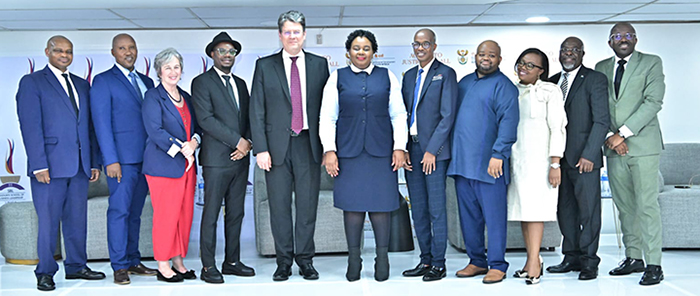
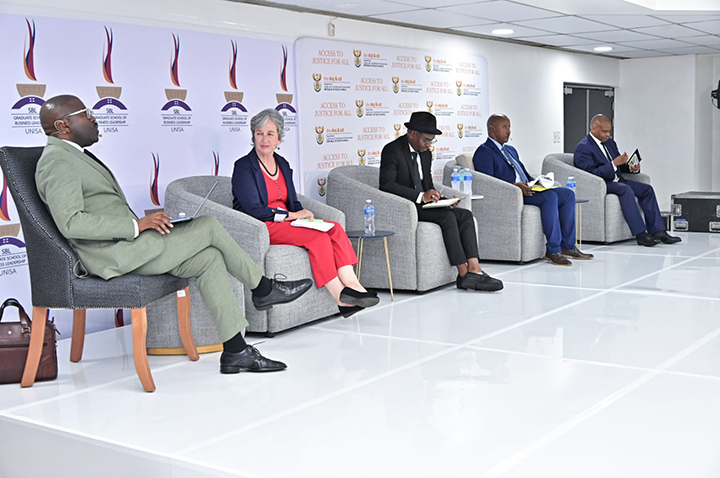
From left: Adv Andy Mothibi (NDPP), Leonard Lekgetho (SIU), Antoinette Slabbert (National Press Club), Prof Paul Mudau (Unisa), Deputy Minister Andries Nel (DOJ & CD), Minister Mmamoloko Kubayi (DOJ & CD), Prof Mpho Ngoepe (Unisa), Prof Walter Matli (Unisa SBL), Mosidi Mokgele (National Press Club), William Baloyi (GovZA) and Albi Modise (GMA)
On 29 April 2026, the Unisa Graduate School of Business Leadership (SBL), in collaboration with the National Press Club and the Department of Justice and Constitutional Development of the Republic of South Africa, hosted a high-level roundtable on 30 years of the Constitution to reflect on progress made, confront persistent challenges and renew a collective commitment to building a just, inclusive and accountable democracy.
The event brought together academics, government leaders, legal experts, community members, students and the media to engage critically with the Constitution's 30-year journey by discussing achievements, challenges and the renewal of a shared commitment to accountable democracy.
In his welcome address, Prof Mpho Ngoepe, Unisa's Vice-Principal for Research, Postgraduate Studies, Innovation and Commercialisation, spoke on behalf of Principal and Vice-Chancellor, Prof Puleng LenkaBula. He described South Africa's Constitution as a living document that has shaped not only the country's laws but also how society envisions itself.
Ngoepe emphasised the significance of the roundtable in bringing together three distinct communities – the government, academia and the media – each with different responsibilities but a shared obligation to the public. The government is responsible for delivery and accountability, academia focuses on evidence, insight and long-term thinking, and the media is dedicated to communicating truth, asking difficult questions and keeping the public informed.
"Therefore, if we approach this as a systems conversation, we must recognise that no single sector can solve all the issues on its own," he said. Ngoepe noted that meaningful progress occurs when systems learn, when data is integrated with lived experiences, when policies align with practical realities and when public dialogue becomes more constructive rather than combative.
Mosidi Mokgele opened by setting the scene from the media's perspective. "As media, we have told the story of transformation, exposed corruption and amplified the voices of the vulnerable," she said. "When the Constitution worked, we recorded it; when it was violated, we revealed it; and when people were forgotten, we reminded the nation of their existence."
She asserted that this is both the role and patriotic duty of the media. "In a constitutional democracy, a free, independent and sometimes uncomfortable press is not a threat to freedom; it is a vital part of freedom."
In concluding her remarks, Mokgele highlighted the importance of the National Press Club's collaboration with Unisa in promoting thought leadership that connects the newsroom with the classroom – where evidence meets ethics and scholarship meets real-time scrutiny. Together, she noted, these spaces allow ideas to be tested and ensure that the Constitution is not only studied but also challenged and strengthened.
Deputy Minister of Justice and Constitutional Development, Andries Nel, reaffirmed the government's commitment to the Constitution, stressing that it must be popularised and understood not only in terms of rights but also in terms of the responsibilities citizens carry in giving those rights meaning. He noted that the Cabinet has launched a year-long, society-wide campaign aimed at laying the foundation for sustained constitutional awareness and action.
"Its focus is clear: reaffirm constitutional values, educate and engage citizens – especially the youth – evaluate democratic progress, promote the rule of law, strengthen accountability, foster unity and recommit to transformation," he said.
In her keynote address, Minister of Justice and Constitutional Development, Mmamoloko Kubayi, highlighted that as South Africa marks three decades since the adoption of the Constitution. The milestone offers both a moment of pride and a call to action. Under the theme "30 years of the Constitution: one Constitution, one nation – reflect, renew, recommit", the commemoration invites citizens to reflect on how far the country has come and how far it still needs to go.
Kubayi briefly described the context in which the Constitution was adopted in 1996, noting that it emerged from a painful history of colonialism and apartheid – systems that institutionalised inequality and stripped millions of their dignity. She explained that the Constitution laid the foundation for a democratic state grounded in human rights, equality and freedom.
"Central to this framework is the Bill of Rights, which guarantees not only civil liberties but also socio-economic rights such as access to housing, healthcare and education, positioning South Africa as a global model of rights-based governance," she said.
Kubayi stressed that over the past 30 years, the Constitution has played a critical role in shaping democratic institutions and promoting accountability. She acknowledged the importance of Chapter 9 institutions in ensuring that no one, regardless of power, is above the law. Freedoms of expression, association and belief have enabled South Africans to engage openly, even amid deep divisions, reinforcing a culture of tolerance and inclusion.
At the same time, she recognised growing concerns about the Constitution's impact in the face of persistent poverty, unemployment and inequality. "Service delivery challenges, such as unreliable electricity, water shortages and failing infrastructure, have eroded public trust," she noted. These realities, she argued, reveal a critical gap: while the legal framework is robust, its implementation has often fallen short due to administrative weaknesses, corruption and limited resources.
Importantly, Kubayi emphasised that the Constitution was never intended to be static. Rather, it is a living document that evolves alongside society and encourages ongoing dialogue and reform through democratic processes.
Looking ahead, she stressed the continued importance of key societal actors. "Academia must continue to provide evidence-based research to inform policy and enhance understanding of constitutional impact," she said. "The media carries the responsibility of informing the public, exposing wrongdoing and amplifying marginalised voices. Ultimately, the 30th anniversary is not just a celebration, but a reminder of shared responsibility," she added.
While the Constitution has laid a strong foundation, its transformative promise depends on collective action. As South Africans reflect on the past, they are equally called to renew their commitment to justice, equality and nation-building. She concluded that the journey of constitutional democracy is ongoing, noting that its success will ultimately be measured not only by the strength of its laws, but by the lived realities of its people.
The roundtable discussion, moderated by Albi Modise, centred on the theme "30 years of the Constitution: reflecting on progress, confronting challenges, renewing commitment". Key panellists included Antoinette Slabbert, Chairperson of the National Press Club, Prof Paul Mudau from Unisa, Leonard Lekgetho, Acting Head of the Special Investigating Unit (SIU), and Andy Mothibi, National Director of Public Prosecutions.
The roundtable underscored the collective commitment of all stakeholders to reflect on, renew and reaffirm their dedication to the Constitution. Participants emphasised that this commitment is essential to strengthening public trust and ensuring that the Constitution remains a foundational pillar of democracy. Through collaborative engagement, stakeholders aim to uphold constitutional values, advance social justice, reinforce the rule of law, and promote unity and accountability in society while addressing the needs and concerns of communities.
The event concluded with a vote of thanks delivered by Prof Walter Matli, Executive Dean and Chief Executive Officer of Unisa SBL, who acknowledged the valuable contributions of the speakers, panellists and participants
* Article compiled by Talana Lebelo, Alumni Relations Specialist, Unisa Graduate School of Business Leadership
** Photography by Shooheima Champion, Multimedia Centre
Publish date: 2026-05-12 00:00:00.0
 Transitioning programme to bolster Unisa's academic ranks
 Unisa strengthens its alliance with those who served in the service of humanity
 Unisa roundtable reflects on constitutional progress and strengthening democratic commitment
 Unisa alumni step forward to strengthen postgraduate supervision
 Cutting-edge AI specialist to address formal opening of R&I Week 2026