

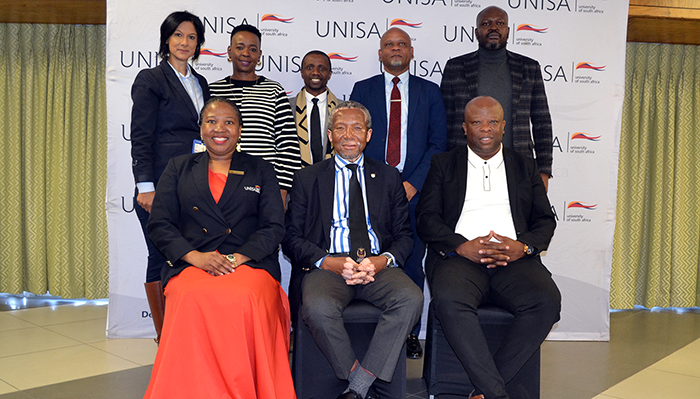
Seated, from left: Dr Mantepu MaseTshaba, Acting Executive Dean, CEMS; Prof Solomon Magano, Vice-Principal of Institutional Development; Bongani Ndaba, Executive Director: HRD
Standing, from left: Lynette Naidoo, Acting Director: Organisation Development and HRIS; Dr Phumza Makgato-Khunou, Director: DISS; Dr Jabulani Nene, Head: Centre for Professional Development (CPD); Dr Benni Lekubu, Acting Deputy Registrar (Governance); and Risenga Masingi, Acting Director: HR Centralisation Services
On 11 May 2026, Unisa’s Human Resources Department (HRD) and Department of Tuition Support and Facilitation of Learning’s (DTSFL’s) Directorate: Institutional Support and Services (DISS), jointly launched the Career Transitioning Programme, which provides support and professional development for staff seeking a career in academia.
The initiative, extending over two years, aims to redesign the Unisa workforce to ensure a fit-for-purpose organisational structure. Prof Solomon Magano, Vice-Principal of Institutional Development, spoke on behalf of Prof Puleng LenkaBula, Unisa Principal and Vice-Chancellor, and gave a brief overview of the venture.
"This initiative was established to address the challenges faced by the institution, particularly the imbalance between the academic staff component and the support and professional staff component," Magano said. He highlighted excessive workload as one of the key issues faced by academics. He said that this initiative aims to balance all components to ensure the university's success and the satisfaction of its clientele.
Bongani Ndaba, Executive Director of Human Resources, outlined the programme's purpose and goals. He emphasised that the initiative's purpose is to provide a seamless transition for staff moving into the academic track, while supporting the university’s focus on academic excellence and project-driven outcomes. "Additionally," he said, "this initiative promotes career mobility and professional development opportunities, while adopting a performance-based approach to retraining and redeploying staff members to utilise existing skills and new capabilities better."
Dr Phumza Makgato-Khunou, who heads the Directorate: Institutional Support and Services (DISS) in the DTSFL, stated that DISS will be responsible for training participants. She highlighted that the focus of DISS is on academic preparedness and professional development, and that the directorate specialises in research development and scholarship support.
Headed by Dr Jabulani Nene, the Centre for Professional Development (CPD) under DISS contributes to the initiative by offering its expertise in teaching and learning methodologies and theories, curriculum and assessment practices, digital and educational technologies, academic professional practices, career readiness and transition skills, as well as mentorship and coaching.
Makgato-Khunou further highlighted the programme's benefits, including empowering staff through meaningful career mobility, strengthening academic capacity, enhancing institutional excellence, and fostering a sustainable culture of lifelong learning, growth and professional development. Overall, she noted the collaborative measures taken by the various developments during the establishment of this initiative and said that these demonstrate a unified institutional effort.
Makgato-Khunou commended the CPD for its continuous and instrumental role in spearheading this initiative. Rounding up her remarks, Makgato-Khunou noted that upon completion of the programme, participants will be fully equipped with the skills to become competent online educators.
Dr Mantepu MaseTshaba, Acting Executive Dean of the College of Economic and Management Sciences (CEMS), provided an overview of the teaching and learning approaches that participants will be expected to apply across their career pathway. She affirmed that teachers must integrate epistemologies and multilingualism into their teaching and learning to ensure it is student-centred. She emphasised the importance of communication, transparency and trust between the teachers and learners to ensure a successful strategic impact for the institution.
Executive Dean of the College of Graduate Studies (CGS), Prof Tennyson Mgutshini, spoke on research innovation as a critical discipline that educators will greatly utilise as they are a part of a research-driven university. "Research makes use of technical and soft skills," he remarked, "which will be developed. These include academic writing, collaboration and navigating professional dynamics."
Mgutshini emphasised Unisa’s strong commitment to developing capable and successful researchers through structured support programmes. He highlighted that tailored support systems and research programmes are available to meet individual needs and to ensure growth at each person's level of readiness.
Dr Genevieve James, Deputy Director: Engaged Scholarship, emphasised that the programme reflects Unisa’s commitment to being transformative and that this initiative is designed to enable staff members to contribute meaningfully to change and transformation, which are central to the higher education mandate.
James further noted that this initiative will harness staff members' strengths to support their academic and professional advancement. "This will encourage staff to become active change-makers by connecting institutional knowledge with societal needs to address and solve real-world issues," she said. James reaffirmed that this initiative will help individuals reposition themselves in academia, build networks and connections, and contribute to social transformation and engagement.
* By Nontsikelelo Ndebele, Communications Intern, Department of Institutional Advancement
** Photography by Victor Malatji, Communications Intern, Department of Institutional Advancement
Publish date: 2026-05-13 00:00:00.0
 Transitioning programme to bolster Unisa's academic ranks
 Unisa strengthens its alliance with those who served in the service of humanity
 Unisa roundtable reflects on constitutional progress and strengthening democratic commitment
 Unisa alumni step forward to strengthen postgraduate supervision
 Cutting-edge AI specialist to address formal opening of R&I Week 2026