
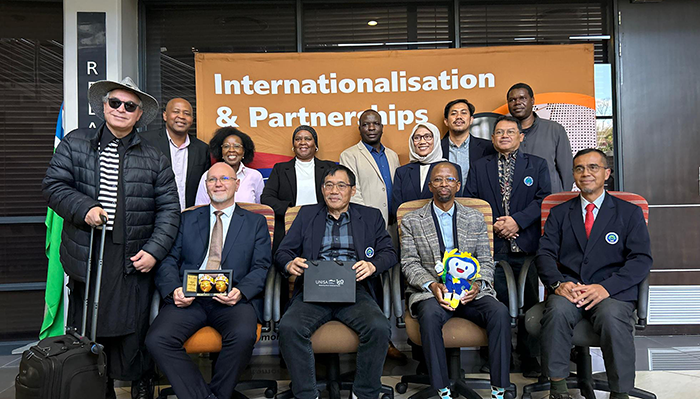
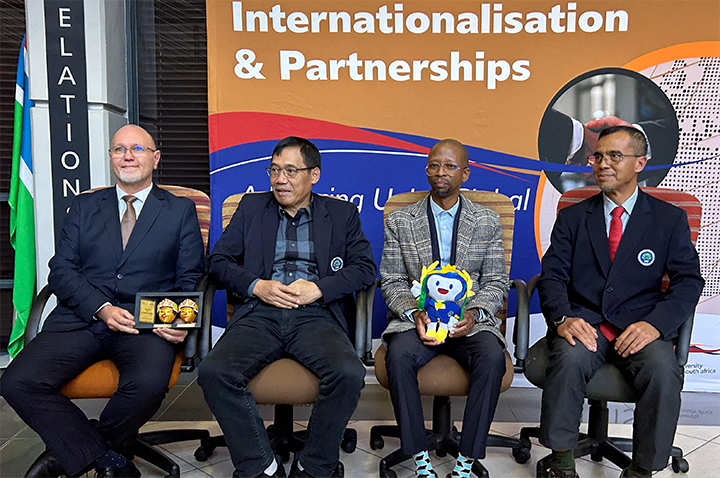
Unisa representatives and delegates from Universitas Negeri Malang
The Directorate of Internationalisation and Partnerships in Unisa’s Department of Institutional Advancement (DIA) successfully hosted collaborative engagements with Universitas Negeri Malang (UM) of Indonesia on 22 June 2026 at Unisa’s Muckleneuk Campus. Discussions focused on deepening cooperation between the two institutions and mapping out joint opportunities in research, training and mobility.
UM, a state university, was established in 1954, making it one of the oldest teaching institutions in Indonesia, the world's fourth most populous country.
In his welcome address, Prof Boitumelo Senokoane, Acting Executive Director of DIA, warmly welcomed the UM delegation led by Rector Prof Dr Hariyono Hariyono and Vice-Rector Prof Markus Diantoro. In his remarks, Senokoane expressed sincere gratitude to the delegation for choosing to collaborate with Unisa and reaffirmed the university’s commitment to building meaningful international partnerships that promote academic excellence, research collaboration and global knowledge exchange.
Highlighting Unisa’s global outlook, Senokoane emphasised the institution’s unique position as Africa’s leading open, distance and e-learning university, with a strong continental footprint and an inclusive approach to higher education. He noted that strategic collaborations such as this strengthen Unisa’s mission to expand opportunities for innovation, student and staff mobility, and impactful research that contributes to sustainable development in Africa and beyond.
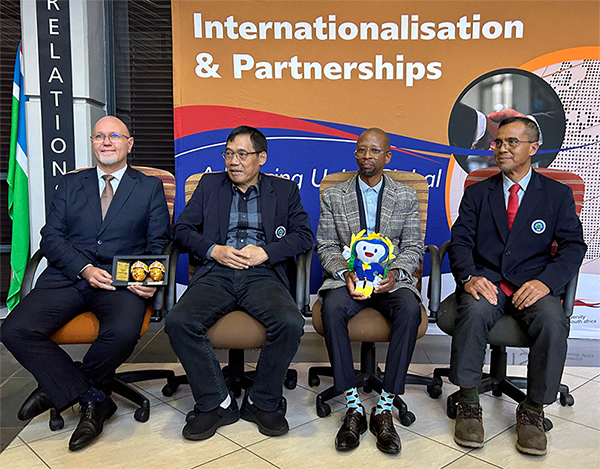
From left: Prof Lessing Labuschagne, Prof Dr Hariyono Hariyono, Prof Boitumelo Senokoane and Prof Markus Diantoro
Hariyono emphasised UM’s interest in working together with Unisa. He said this commitment reflects the Government of Indonesia’s broader push to collaborate with African countries. "This collaborative engagement will also focus on establishing research opportunities for international funding, enhancing student mobility programmes and staff exchanges, and promoting joint publication," said Hariyono. He encouraged both institutions to facilitate international student service-learning and to conduct international community engagement projects in Indonesia and South Africa. "We can learn from each other and grow together," he added.
Diantoro highlighted that Unisa and UM will work together in research and publication, co-hosting conferences, applying for UM’s internal Matching Fund schemes, and developing postdoctoral research schemes. He highlighted that UM and Unisa can build an international research network with Unisa as hub to tackle transnational problems stemming from history, culture and education.
Commenting on education and training, Diantoro said UM and Unisa can design joint training programmes for school managers, collaborate on postgraduate student recruitment, and run co-teaching, joint supervision and joint examiner activities. He called for the institutions to jointly develop online and distance learning programmes. In conclusion, Diantoro emphasised the value of student collaboration and called on both universities to jointly develop online and distance learning programs.
Prof Lessing Labuschagne, Executive Director of Research, Innovation and Commercialisation at Unisa, welcomed UM’s commitment to research collaboration. He explained that Unisa operates as a large university with a hybrid model comprising colleges that have their own research and innovation capacity. These colleges are supported by a central unit dedicated to advancing research. Unisa’s ten catalytic niches drive research and innovation and align closely with the United Nations’ Sustainable Development Goals. He added that both institutions have significant research strengths and share a clear synergy in their research and innovation goals.
* By William Thubakgale and Victor Malatji, Department of Institutional Advancement
** Photography by Godfrey Mahloko, Directorate of Internationalisation and Partnerships
Publish date: 2026/06/23
 Resilience beyond the finish line
 Unisa welcomes Universitas Negeri Malang
 Perseverance, purpose and the power of education
 Blind student graduates with master's degree at Unisa
 Unisa takes African scholarship and sustainability leadership to the global stage in Jakarta