
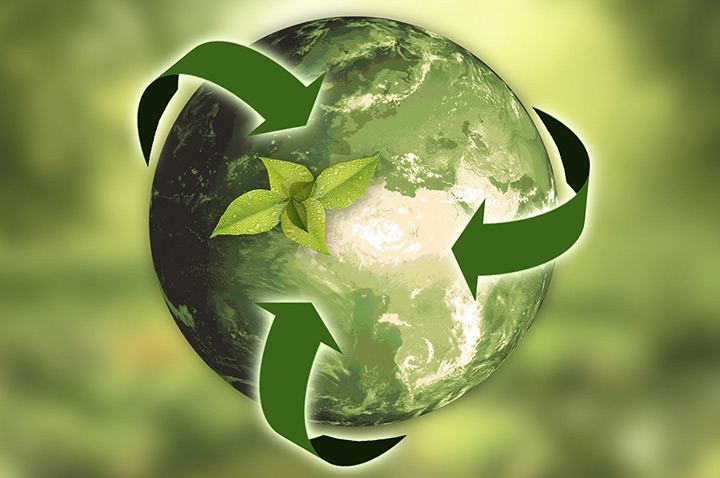
The Directorate: Sustainability, Monitoring and Evaluation, in the Department of Quality Assurance and Enhancement, hosted a comprehensive one-hour webinar on 31 March 2026 to commemorate Earth Hour, Human Rights Day and World Water Day.
The session, themed When Water Leads, Humanity Rises: Building a Resilient and Dignified Earth, brought together Sustainable Development Goal (SDG) Liaison Committee Members and other university staff and stakeholders to reflect on the interconnectedness of environmental stewardship, human rights and water security. The webinar formed part of the institution’s ongoing commitment to advancing sustainability awareness and encouraging meaningful dialogue on these matters across the university community.
Nomi Mnotoza, in her opening remarks, welcomed participants and highlighted the significance of commemorating the three global observances (Earth Hour, Human Rights Day and World Water Day) together. She emphasised that sustainability, human dignity and equitable access to resources are inseparable and that higher education institutions have a responsibility to lead conversations that translate knowledge into action. She encouraged participants to actively engage throughout the session and reflect on their individual and institutional roles in advancing sustainability initiatives.
The keynote address was delivered by Sanelisiwe Precious Miya, Principal Technician: Science Collections at the South African National Biodiversity Institute (KZN Herbarium) and Student Sustainability Champion. She holds a BSc Honours degree in Environmental Management and is currently completing her MSc at the University of South Africa. Her professional work bridges biodiversity conservation, scientific data management and inclusive community engagement to strengthen conservation outcomes and equitable stewardship of natural resources.
In her presentation, entitled "When Nature Fails, People Suffer", Miya provided a compelling narrative linking climate change, water security and human rights. She emphasised that while Earth Hour, Human Rights Day and World Water Day are often commemorated separately, they represent interconnected dimensions of the same global challenge. She highlighted that environmental degradation undermines human dignity and disproportionately affects vulnerable communities.
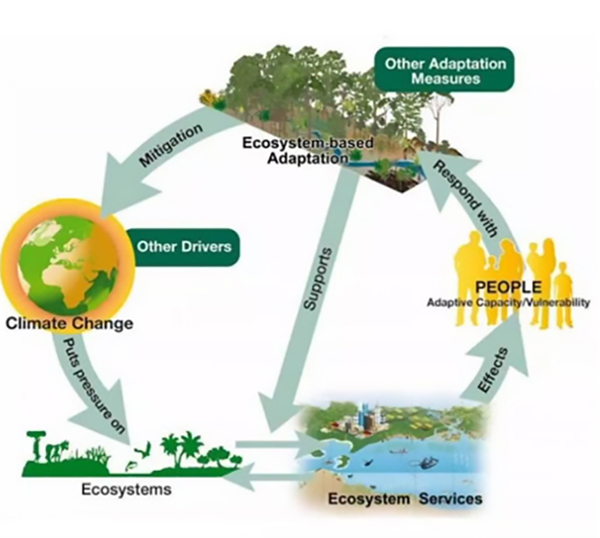
Ecosystem-based adaptation
Miya illustrated how climate change intensifies environmental risks, particularly in water-scarce countries such as South Africa. She explained that climate change is not limited to temperature increases, but includes biodiversity loss, ecosystem collapse and disruption of livelihoods. She also emphasised that water insecurity is frequently linked to issues of access, infrastructure and management, rather than absolute scarcity.
Drawing from both global and local contexts, she demonstrated how degraded ecosystems affect livelihoods, health and social stability. She explained that when wetlands, rivers and catchments deteriorate, communities face increased flooding, reduced water quality and diminished food security. These environmental challenges, she noted, ultimately translate into human rights concerns.
Miya further highlighted the constitutional right to water and emphasised that access to clean and reliable water remains uneven across communities. She challenged participants to consider water distribution inequalities and the importance of sustainable management practices. She also stressed that infrastructure challenges and socio-economic disparities continue to influence water security.
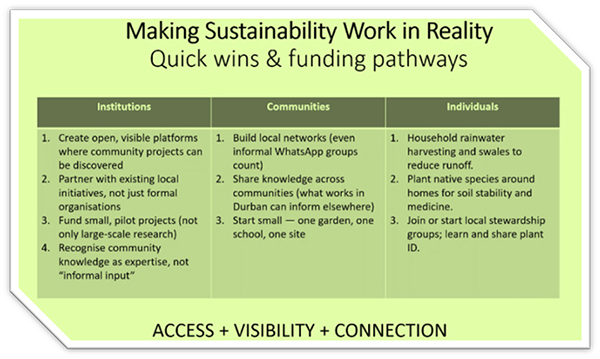
Making sustainability work in reality
A key theme that emerged from Miya’s presentation was the importance of collaboration between institutions, communities and individuals. She emphasised that sustainability solutions already exist within communities, but often remain fragmented due to institutional silos. She advocated for improved partnerships, recognition of local knowledge and stronger support for community-led initiatives.
Participants were encouraged to consider their individual roles in advancing sustainability. Miya proposed practical interventions, including ecosystem-based adaptation, climate-smart agriculture, improved infrastructure planning and enhanced communication of research findings. She stressed that sustainability begins with connected people and collective action.
The programme director, Refiloe Tsephe, encouraged participants to reflect on the implications of the presentation and highlighted South Africa’s biodiversity significance and the importance of protecting natural resources as part of economic and social development. Her comments reinforced the need for collaborative approaches to sustainability and encouraged dialogue among participants.
During the interactive discussion, participants reflected on how research outputs can and should be translated into practical vehicles with community impact. Miya emphasised that research should be designed with community benefit in mind, with outcomes shared in accessible language. She encouraged academics to extend their work beyond scholarly publications and engage directly with communities to ensure a lasting impact.
In the closing reflections, Dr Nompe Ntombela expressed appreciation to the keynote speaker and participants. She noted that the webinar highlighted the urgency of addressing environmental challenges and the shared responsibility of institutions and individuals. Ntombela emphasised that climate change is a lived reality affecting vulnerable communities and called for intentional action to build a resilient and dignified future.
The webinar concluded with a renewed commitment to sustainability, collaboration and community engagement. Participants acknowledged the role of higher education institutions in producing graduates who can act as change agents and contribute to environmental resilience. The session reinforced the importance of interdisciplinary approaches and collective responsibility in overcoming sustainability challenges.
The event successfully deepened understanding of the link between environmental sustainability, water security and human rights. It also highlighted the importance of universities as vehicles for ensuring research translation, community engagement and institutional collaboration to advance sustainability initiatives within the university and beyond.
* By Nomi Mnotoza, Administrative Officer: Directorate: Sustainability, Monitoring and Evaluation, Department of Quality Assurance and Enhancement
Publish date: 2026-04-16 00:00:00.0
 Unisa Mining Engineering team earns prestigious industry recognition
 Unisa explores strategic collaboration to intensify its music education
 Unisa webinar links Earth Hour, Human Rights Day and World Water Day
 Reimaging masculinity at Unisa
 Engineering resilience