
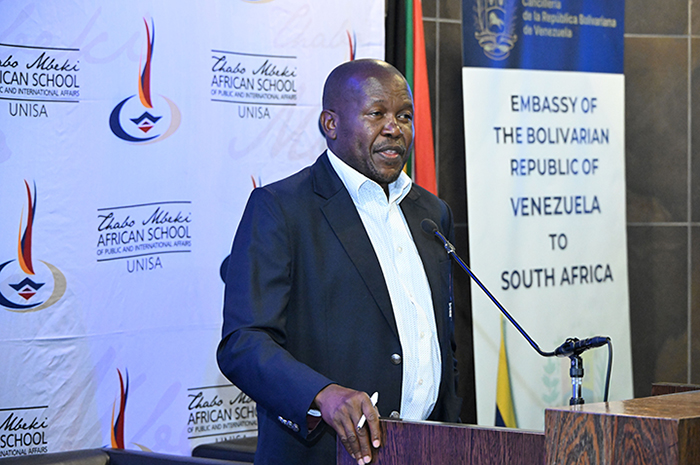
Prof David Mello
On 3 February 2026, the Thabo Mbeki African School of Public and International Affairs at Unisa hosted a seminar under the theme "The US casus belli in Venezuela or the 'Right-to-Protect' doctrine".
Dr Angie Magabane, the Director of Internationalisation and Partnerships in the Department of Institutional Advancement at Unisa, facilitated this seminar. Magabane welcomed all delegates and introduced Prof David Mello, Acting Director: Academic Programmes at the Thabo Mbeki African School of Public and International Affairs.
Mello emphasised the school’s commitment to tackling global challenges through intellectual discourse and provided a brief overview of the points of discussion, including the events that unfolded in Venezuela on 3 January 2026, which he labelled an "American invasion". He then introduced the dignitaries and panellists, including Dr Carlos Feo Acevedo, the Ambassador of the Bolivarian Republic of Venezuela to South Africa, and Dr Kingsley Makhubela, a veteran and scholar of international relations and former South African diplomat. Mello acknowledged the presence of members of the diplomatic corps, including Dr Andre Zabayke, as well as the Ambassador of the Central African Republic. In closing, he encouraged the audience to consider whether the United States' (US) invasion of Venezuela was in accordance with international law and whether academic publications could explain US action. Additionally, he wondered whether the United Nations (UN) could resolve this global issue.
Dr Chido Nyere, a post-doctoral research fellow at the school, sketched a brief background to the discussion. He reminded the audience of the events of 3 January 2026, which took the world by surprise. On that day, the United States’ special forces invaded Venezuela, a sovereign state. They captured President Nicolas Maduro on charges of narco-terrorism, corruption, drug trafficking and money laundering, among other things.
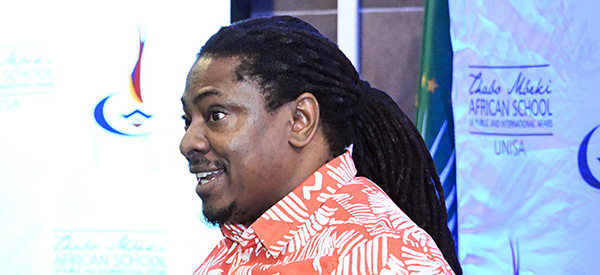
Keynote speaker Dr Chido Nyere
In his address, Nyere described the invasion as alarming and a blatant violation of international law by the US. Three points stood out, he said: "First, the invasion of a sovereign state by another goes against the doctrine of state sovereignty, which is the primary tenet of international law; second, the illegal abduction of a sitting president of a sovereign state, and the prosecution of the Venezuelan first citizen using US law are indicative of a US that holds the established rules in a rules-based world order in contempt; and third, there is a view that the invasion of Venezuela and the subsequent abduction of its president are a result of President Nicolas Maduro’s actions as he is accused of corruption in his bureaucracy and domestic policy, and his style of leadership with some pundits arguing that Maduro is a dictator and an authoritarian ruler."
He continued: "While some allegations against President Nicolas Maduro may be valid, especially that he has presided over a corrupt bureaucracy in his domain, the legitimacy and legality surrounding the invasion of Venezuela and his abduction and capture weakens the US moral authority to prosecute Maduro, taking into consideration that the first US citizen, President Donald Trump, stands accused of violating international law, let alone his country’s laws, as the Commander-in-Chief of the US military units."
Nyere challenged the audience to find answers to the following key questions:
Diverse perspectives typified this session. Ambassador Acevedo reiterated Nyere’s sentiments that "the US carried out an outrageous, criminal and territorial attack against Venezuela". He claimed that on 3 January 2026, at 02:00, approximately 150 US aircraft entered the Venezuelan airspace and bombed military and civilian targets in the four coastal provinces of Miranda, Aragua, La Guaira and the Capital District, which includes the capital Caracas. More than 100 people were killed in the attack, including 32 Cubans who were part of the presidential security team. About 430 homes were damaged.
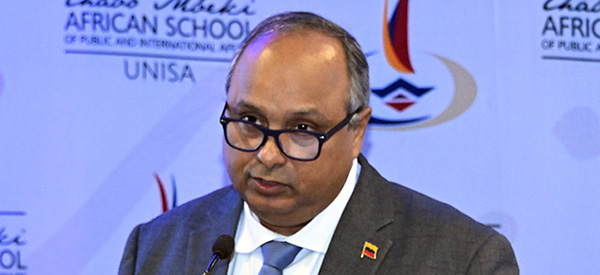
Ambassador Dr Carlos Feo Acevedo
Acevedo said that he regretted the fact that President Maduro and his wife, Cilia Flores, were abducted in what is considered a flagrant violation of international law, the United Nations Charter and even US domestic laws. He described the attack as a declaration of war, not only against Venezuela, but also against the entire world. He called it an indisputable breach of the international legal framework that allows countries to coexist in a context of respect and peace. He quoted Article 2.4 of the UN Charter, which stipulates that "Member States of the Organisation must refrain from the threat or use of force against the territorial integrity or political independence of any State". He added that the US attack constituted the illegal use of force. In this, Venezuela showed no aggression, and the US government had not declared war on Venezuela.
He assured the audience that the Venezuelan Acting President, Dulcy Rodriguez, and the national government of Venezuela remained steadfast in their commitment to defend sovereignty, peace, dialogue and respect through actions with global reach and the participation of movements and peoples from around the world. Venezuela demanded (1) that President Maduro and his wife be released, (2) that the principles of international law, violated by the military aggression of 3 January, be upheld, and (3) that the country’s economic growth be consolidated. In his conclusion, the Venezuelan ambassador thanked the people and government of South Africa for their support. He underscored that, from the onset, South Africa not only strongly condemned the US government’s military intervention in Venezuela but also demanded an end to American aggression and the release of President Maduro and his wife.
Acevedo concluded by exclaiming, "We will resist, we will fight, and we will prevail. Long live Venezuela! Long live international solidarity!"
Makhubela, former director general of the National Department of Tourism and CEO of Brand South Africa, focused on conflicting narratives and underlying motivations. He held that the conflict involves more than merely oil, noting broader geopolitical dynamics and the projection of mineral resources as a source of power. He described the invasion of Venezuela as a geostrategic move by the US to buffer itself against the "unstoppable competition by China and Russia". Makhubela noted that although President Trump’s actions are framed as measures to protect US interests against global competitors, the emphasis on Venezuelan oil reserves may hide a geopolitical agenda. He referred to the Venezuelan ambassador’s statement that US officials’ conflicting statements contribute to the ambiguity surrounding the mission’s purpose. Venezuela holds the world’s largest oil reserves, estimated at approximately 303 billion barrels. Control over them was the reason for US aggression.
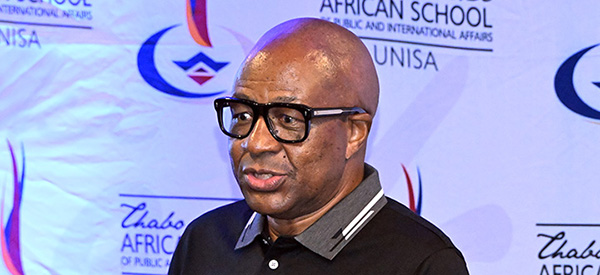
Dr Kingsley Makhubela
"The ambassador had also referred to the contradicting statements of President Trump, Secretary of Defence Pete Hegseth, and Secretary of State Marco Rubio immediately after President Maduro’s abduction," continued Makhubela. "Hegseth framed it as a 'law enforcement operation' aimed at going after 'drug cartels', whereas Rubio spoke of targeting 'dictators' and a 'stolen election'."
Makhubela maintained that the contradictory statements failed to define the mission’s strategic purpose, causing alarm on "the other side of Pennsylvania" (the American Congress). Regarding the legal implications of the attacks, Makhubela held that the US invasion violated international law, specifically Chapter 2 of the UN Charter, which addresses the responsibilities and functions of the state. He concluded that the strategic thrust of the operation was "obscured by a lot of questions".
Advocate Sipho Mantula facilitated the question-and-answer session. During this session, participants expressed great concern about the United States’ violation of international law. They wondered why countries in the Global South would submit to legal processes in the Global North when the Global North is not accountable to anyone. This sparked a discussion of the implications for state sovereignty, highlighting tensions between realist power politics and liberal internationalism, especially for weaker states. Participants also considered the lessons Africa can learn from this situation and how the continent should position itself in today’s global political landscape.
Prof Boitumelo Senokoane, Executive Director of the Department of Institutional Advancement, concluded the discussion by warning the Global South, particularly Africa, to awaken and actively define its role in a world where imperial and colonial tendencies challenge state sovereignty and international law. He called for sustained dialogue, strategic thinking and strong solidarity to navigate these complex geopolitical realities. In conclusion, he highlighted the role of universities in the global context.
* By Dr Koliswa Matebese-Notshulwana and Dr Bongiwe Mphahlele, Post-Doctoral Fellows at the Thabo Mbeki African School of Public and International Affairs
Publish date: 2026-03-05 00:00:00.0

 Unisa research chair seeks home-grown solutions for Africa's energy future
 Unisa African Music Festival puts indigenous music centre stage
 Unisa takes isiZulu to Russia as language programme gains ground at RUDN University
 Minister Manamela calls for systemic reset of South Africa's PSET sector
 Three Unisa women putting science, research and innovation into action