

The keynote was delivered by Prof Thabo Msibi, Deputy Vice-Chancellor, Teaching and Learning, University of KwaZulu-Natal
Unisa is hosting the 3rd International Higher Education Teaching, Learning and Student Support Conference (ITLC 2026) at its Muckleneuk Campus in Tshwane from 4 to 7 May 2026. The official opening of the conference took place on 5 May in the ZK Matthews Great Hall.
Convened under the theme "Hope through Transformation: Advancing Sustainability, Inclusion, and Digital Innovation in Higher Education Practices", the conference creates a platform for critical reflection on the future of teaching, learning and student support in an era of rapid technological change.
The objective of ITLC 2026 is to provide a platform for higher education practitioners, researchers, managers, executives, leaders and policymakers to critically explore the future of higher education, particularly in light of evolving challenges and opportunities in teaching and learning.
The conference focuses on centralising discourse and debate on sustainability, digital transformation, pedagogical practices, institutional resilience, and the long-term well-being of students and staff. These areas call for reimagining curricula, policies and institutional cultures to foster inclusivity, decolonisation and human-centred innovation.
During the conference's opening session, discussions focused mainly on artificial intelligence (AI) and its growing influence on higher education. While AI presents significant opportunities to enhance access, efficiency and personalised learning, speakers repeatedly emphasised that technology is never neutral. Underlying systems of power, knowledge and values shape its design, application and outcomes.
In her opening address, Unisa Principal and Vice-Chancellor, Prof Puleng LenkaBula, cautioned that without intentional and critical engagement, digital technologies risk reinforcing inequality and excluding African epistemologies. In her address, she critically engaged with the future of higher education, technology and artificial intelligence. She stressed the importance of repositioning African universities not as passive recipients of global innovation, but as active producers of knowledge and technology rooted in local realities, languages and cultures.
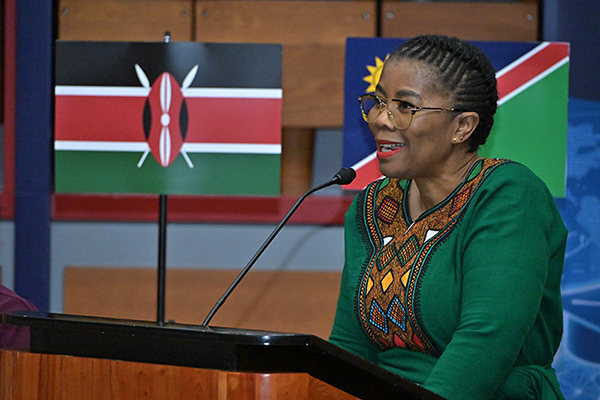
Prof Puleng LenkaBula, Unisa Principal and Vice-Chancellor
Said LenkaBula: "We are living in a time of rapid transformation". She noted that advances in artificial intelligence and digital technologies are reshaping how universities teach, research and produce knowledge. She views the changes AI brings as tools that offer powerful opportunities, from generating content and analysing data to expanding access through mobile connectivity and digital platforms. Nevertheless, LenkaBula urged delegates to embrace these innovations with caution and to ask critical questions, such as "Who designs these systems?". She also enquired whose knowledge they present and who truly benefits from them.
LenkaBula further said that, too often, technologies are imported without adaptation to local realities, which risks reinforcing existing inequalities and reproducing forms of digital colonialism. She further said: "If we are not intentional, AI systems may exclude African languages, cultures and ways of knowing. Higher education institutions across Africa have a responsibility to respond differently."
Building on this, keynote speaker Prof Thabo Msibi, Deputy Vice-Chancellor for Teaching and Learning at the University of KwaZulu-Natal, interrogated the relationship between artificial intelligence, pedagogy and knowledge production. He warned that AI risks replicating Paulo Freire's "banking model" of education, in which knowledge is deposited, reproduced and rarely interrogated.
Msibi argued that AI introduces a new layer to this challenge by creating what he described as an "illusion of competence", where students can generate assignments and outputs without engaging in deep learning. This, he cautioned, risks shifting education from intellectual development to mere performance.
He further raised concerns about the global politics of knowledge embedded in AI systems, noting that most technologies are developed in the Global North. "This," he said, linking to the VC’s address, "often results in the marginalisation of African languages, histories and epistemologies." For him, the urgent task facing African universities is to ensure that they are not only users of AI, but also contributors to its design, ethics and knowledge frameworks.
Responding to the keynote, Dr Morgan Maphutha, Deputy Director for Teacher Education at the Department of Higher Education and Training (DHET), emphasised the policy implications of digital transformation in education. Maphutha noted that while artificial intelligence offers opportunities for innovation, it must be implemented within a human-centred, socially just framework.
Maphutha highlighted the persistent inequalities in the South African education system, particularly the digital divide between urban and rural schools. He cautioned that without targeted interventions, the integration of AI could deepen existing disparities rather than resolve them.
He further stressed the importance of reimagining teacher education to prepare educators who are not only digitally literate but also critically aware of the ethical dimensions of technology. "Teachers," he argued, "must remain central to the learning process, even in an increasingly automated educational environment."
Of importance, the conference concluded with the signing of a memorandum of understanding (MoU) between Unisa and the Department of Basic Education (DBE). The session was facilitated by Dr Angie Magabane, Director of Internationalisation and Partnerships in the Department of Institutional Advancement at Unisa. "This partnership," she explained, "represents a significant step forward – a coming together of institutions with a shared vision."
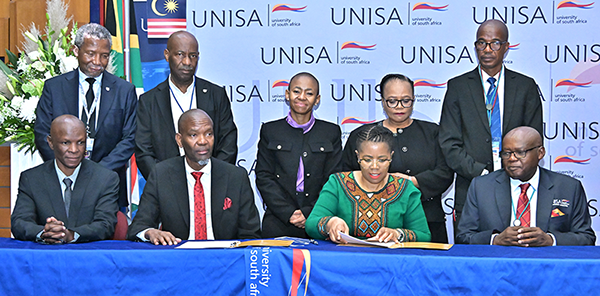
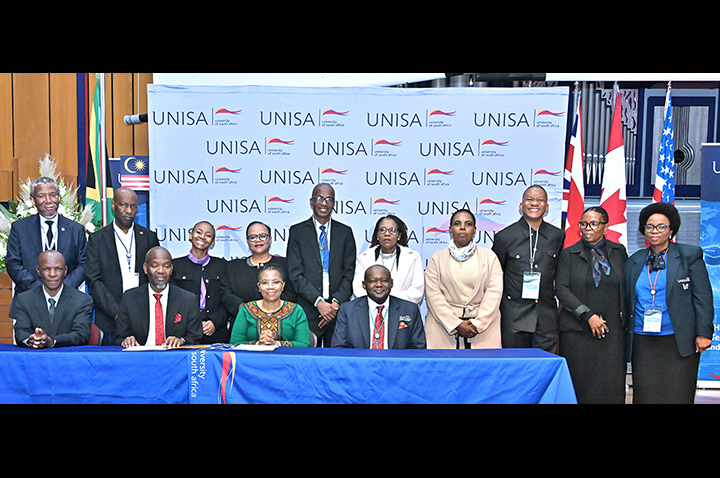
Signing the MoU on behalf of their respective universities were, front row, centre left and right respectively, Seliki Tlhabane, Chief Director for Mathematics, Science and Technology and Curriculum Enhancement Programmes, DBE, and Prof Puleng LenkaBula, Unisa Principal and Vice-Chancellor, flanked by (front, far left) Dr Neo Mothobi, Chief Education Specialist, DBE, and (front, far right) Dr Azwinndini Tshivhase, Acting Vice-Principal: Teaching, Learning, Community Engagement and Student Support, Unisa. Looking on are members of Unisa’s management.
The MoU will focus on several key areas, including
Some of these initiatives are already underway.
Across all interventions, a consistent message emerged: the future of higher education in Africa will be defined not only by technological advancement but by the values that guide its implementation. While artificial intelligence offers powerful tools for transformation, its impact will depend on whether it is used to reinforce existing systems or to reimagine them.
As ITLC 2026 continues, the conference has positioned itself as a critical space for rethinking universities' roles in a rapidly changing world. It challenges higher education institutions to move beyond adaptation and toward intentional transformation—one that is inclusive, ethical and grounded in African realities.
* By Lesego Chiloane, Journalist, Department of Institutional Advancement
** Photography by Shooheima Champion, Multimedia Centre
Publish date: 2026/05/07
 Unisa conference positions Africa at the centre of AI, inclusion and higher education transformation
 Unisa's KwaZulu-Natal Region hosts impactful health and wellness campaign
 Join Unisa Press to celebrate National Archives Awareness Week 2026
 Unisa and Zallywood launch theology short learning programmes
 Unisa project initiates ethical research into traditional law