

The National Association for Student Development Professionals (NASDEV) has called for stronger partnerships between women and men to build ethical, equitable and inclusive institutions across South Africa's higher education and Technical and Vocational Education and Training (TVET) sectors.
The call came as NASDEV opened its three-day conference at the University of South Africa (Unisa) Art Gallery. Held during Women's Month, the conference explored the theme, "Women leading and partnering with men for ethical and equitable institutions," while marking 30 years of advancing student affairs and student development practice in the country.

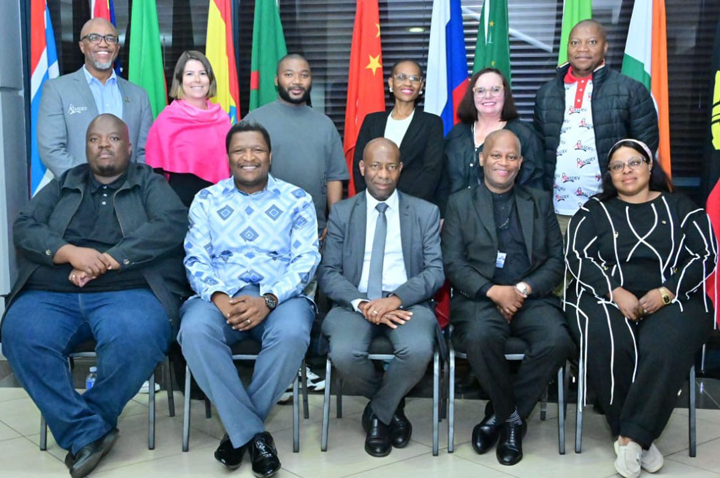
Unisa's Dean of Students, Dr Olwethu Sipuka, Prof Moloko Seputla, the registrar of Unisa, convener of the conference, Trudis Msowoya and other guest who attended the NASDEV conference.
The conference brought together practitioners from across the higher education and TVET sectors to reflect on the changing role of student development and the leadership required to create institutions that are responsive to the needs of their students and communities.
Unisa's Dean of Students, Dr Olwethu Sipuka, placed the discussion within a broader historical context, highlighting the longstanding contribution of women to education and the advancement of knowledge.
Reflecting on the history of higher education, Sipuka referred to Fatima al-Fihri, who is traditionally credited with founding Al-Qarawiyyin in Morocco, an institution widely regarded as one of the world’s oldest existing centres of higher learning.
"854 years after the death of Christ, Fatima, not yet a professor, established a foundation for knowledge expansion in Morocco. An enduring legacy, the first university in the world was established by a woman," Sipuka told delegates.
His remarks connected this historical legacy with the contemporary challenges women continue to face in leadership, particularly within South African educational institutions.
Sipuka noted that, despite the progress made since South Africa's transition to democracy in 1994, more work is needed to address inequalities in senior management and leadership.
He highlighted the need for greater representation of black people and women in senior positions, arguing that institutional transformation requires more than policies. It also requires sustainable leadership models that embrace diversity, inclusion and ethical practice.
Unisa Registrar Prof Moloko Seputla emphasised the importance of ensuring that student development remains responsive to the realities facing South African higher education.
He challenged practitioners to consider how student development should evolve as institutions confront changing social, economic and educational conditions.
At the heart of this evolution, he said, should be the student experience.
The emphasis on accessible and meaningful education reinforced the broader message of the conference: that institutional transformation should ultimately improve the experiences and opportunities of students.
Conference convener Trudis Msowoya highlighted the importance of women and men working together to develop ethical leadership frameworks.
"As institutions navigate an increasingly complex world, the significance of collaboration cannot be overstated," Msowoya said.
Her remarks reflected the central message of the conference, which was not simply about increasing the number of women in leadership, but about creating institutional cultures in which women and men can work together to advance equity, integrity and meaningful transformation.
Discussions also focused on the need for sustainable innovation, resilience and inclusion as institutions respond to the pressures facing the education sector.
These challenges include financial constraints, mental health concerns and rapid changes in the world of work and education. For student development professionals, they raise important questions about how institutions can provide support that remains relevant to students while preparing them for an uncertain future.
The conference's 30th anniversary provided an opportunity to reflect on the progress made in student affairs and student development over the past three decades, while also considering the work that remains.
Through discussions, networking opportunities and excursions, delegates were given opportunities to share experiences, exchange ideas and explore potential areas of collaboration.
The conference also created space for practitioners from different institutions and backgrounds to consider practical ways of strengthening leadership and addressing barriers that continue to affect underrepresented groups.
As NASDEV marks three decades of advancing student development practice, the conference has positioned the next chapter around a clear challenge: celebrating progress while confronting the institutional barriers that still stand in the way of genuine equity.
For the higher education and TVET sectors, the conversation is ultimately about more than women's leadership. It is about building institutions where ethical leadership, diversity and inclusion are embedded in how decisions are made and where the student experience remains central to institutional transformation.
* By Sipho Jack, Journalist, Department of Institutional Advancement
Publish date: 2026-08-20 00:00:00.0

 NASDEV Conference celebrates women's leadership and calls for ethical, equitable institutions
 Turning data into opportunity for mathematics learners
 Skills for a shared future: Preparing young people for an AI-driven world of work
 From geology to rock engineering: Unisa alumnus graduates cum laude while championing safer mining
 Unisa law students take on Africa's leading human rights moot court competition