
Artificial intelligence (AI) is rapidly reshaping higher education, promising efficiency and innovation. However, beneath this optimism lies a more challenging reality: universities are not using AI to stamp out inequality; instead, they risk embedding it more deeply into their systems.
This was the central message at a high-level AI and Disability Workshop hosted by Unisa Library and Information Services (LIS) on 26 March 2026. Academics, technologists and disability advocates examined whether AI is advancing inclusion or reinforcing exclusion. The conclusion was clear: AI is not neutral – it amplifies what already exists, whether fairness or bias.
AI systems are already being used in admissions, assessment and student support. When built on incomplete or biased data, they replicate these gaps at scale. As Dineo Moseki, a dedicated professional at the Advocacy and Resource Centre for Students with Disabilities (ARCSWiD), noted that fairness in AI requires deliberate design, inclusive data and accountability – it does not occur automatically.
At the core of the issue is a flawed assumption: that technology is objective. It is not. AI learns from historical data and that data reflects existing inequalities. If students living with disabilities are excluded from that data, they are excluded from the outcomes.
Dr Khomotso Marumo, Director of Client Service at Unisa LIS, warned that "innovation without ethics is not progress, it is risk", highlighting the consequences of deploying systems without fully understanding their impact.
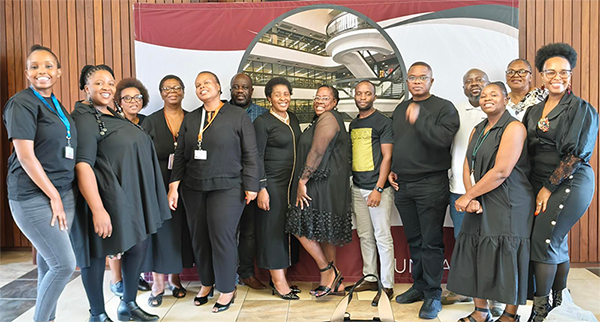
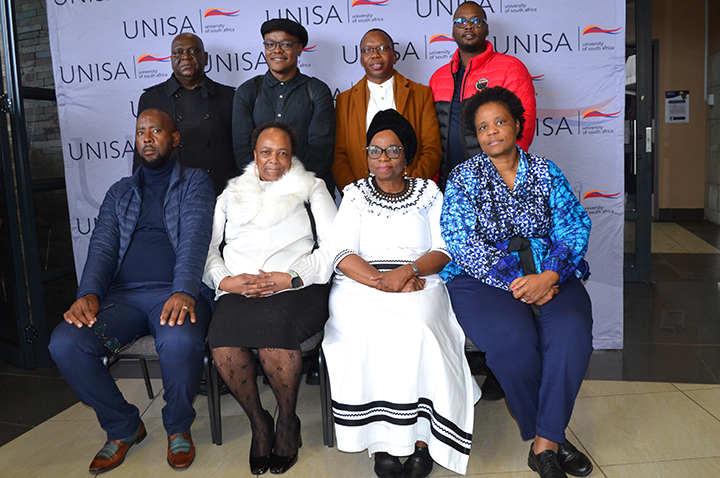
AI and Disability Workshop organising committee
Dr Tony Matjila, Research Training and Development Officer at the Unisa School of Interdisciplinary Research and Graduate Studies (SIRGS) in the College of Graduate Studies (CGS), challenged the foundations of higher education. He argued that institutions are built around an imagined "standard" student – fast, independent and uniform. "We are designing education for a 'standard' human that does not exist."
AI reinforces this model instead of challenging it. Systems trained on narrow definitions of performance continue to advantage some students while disadvantaging others. In this context, disability is treated as a deviation rather than a valid form of diversity.
Attempts to retrofit inclusion into these systems are failing because they were never designed to accommodate diverse realities.
Digital inequality remains a major barrier. Many students still lack reliable internet access, appropriate devices and assistive technologies. This is not merely a technical gap; it reflects institutional priorities.
Universities are investing in advanced technologies while neglecting the infrastructure required to make them accessible. At the same time, internal silos between departments continue to undermine inclusion efforts.
"Inclusion fails where institutions work in silos," said Dr La-Portia Mahlangu-Matjila, Unisa alumna.
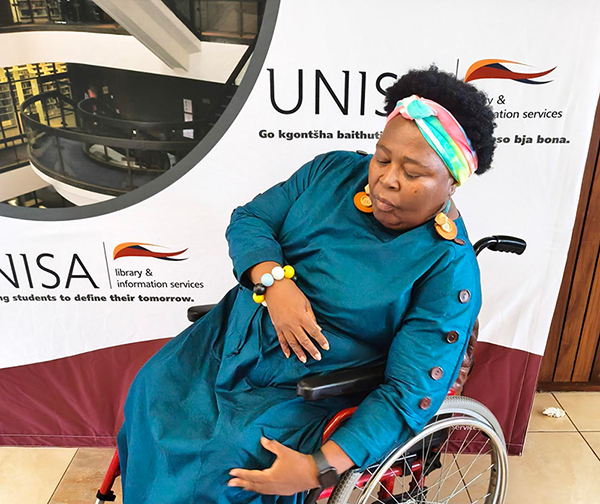
Dr La-Portia Mahlangu-Matjila
However, this is more than a coordination issue; it is a leadership challenge. Inclusion is not consistently enforced as a system-wide priority. There are also growing concerns around data privacy, particularly when sensitive disability data is used without robust safeguards.
The problem is no longer a lack of awareness. Universities understand the risks. The real question is whether they are willing to make the structural changes required, including redesigning systems, investing in access and enforcing accountability.
AI is already shaping who gains access, who succeeds and who is excluded. If institutions continue on their current path, exclusion will not disappear; it will become faster, less visible and more difficult to challenge.
The issue is not whether AI will transform higher education – it already is. The real question is: who gets left out?
* By Itumeleng Mpete, Marketing Coordinator, Library and Information Services
Publish date: 2026-04-20 00:00:00.0
 Masterclass unpacks the power of glocalisation in global marketing
 Unisa and NPC expand partnership to promote the journalism profession
 Unisa's renowned scholars nominated for South Africa's Science Oscars
 Unisa celebrates the life and legacy of Miriam Makeba
 Unisa seminar examines cultural knowledge and language as key ingredients of ubuntu