
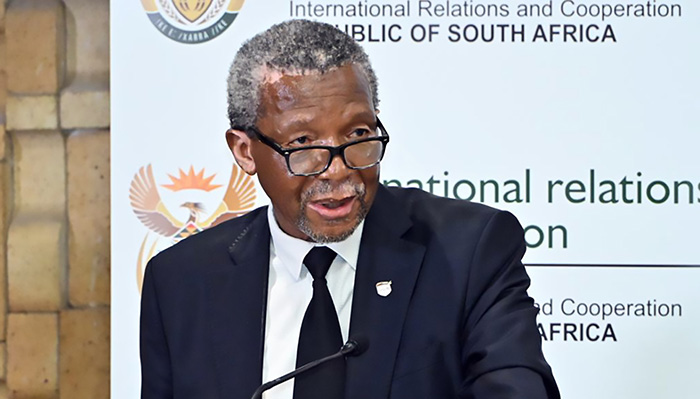
Prof Solomon Magano, Unisa Vice-Principal: Institutional Development
On 8 April 2026, Unisa, in partnership with the Department of International Relations and Cooperation (DIRCO), hosted a high-level roundtable to discuss the ongoing geopolitical tensions triggered by the United States-Israel war with Iran and the ongoing conflicts in the Middle East. The roundtable was themed International law, diplomacy, and multilateralism for peace in the context of war: Iran and the Middle East.
The discussion brought together diplomats, academics, civil society representatives, humanitarian experts and students to engage on these critical geopolitical developments and to discuss how peace agreements underpinned by justice can be upheld equally across the globe.
In his welcome address, Prof Solomon Magano, Unisa Vice-Principal of Institutional Development (speaking on behalf of Unisa Principal and Vice-Chancellor, Prof Puleng LenkaBula), lamented the ongoing conflicts and their devastating impact on humanity, expressing that even the international laws agreed upon by states are not being enforced. "The Geneva Conventions of 1949 and the Additional Protocols of 1977 state that schools and hospitals must be zones of peace, where children are granted protection, especially in times of conflict," he stated. "Yet, there is an increasing trend of schools, institutions of higher learning and hospitals being attacked with detrimental effects on children. These are considered grave breaches of the Geneva Conventions and international humanitarian law, and constitute war crimes."
Concluding his remarks, Magano emphasised that the outcome of the dialogue should focus on finding lasting peace through diplomacy and the interrogation of international laws and treaties, and empowering internationally established courts, such as the International Court of Justice and the International Criminal Court, to find their voice in the current geopolitical conflicts and wars.
Speaking next, Ambassador Xolisa Mabhongo, Deputy Director-General: Global Governance and Continental Agenda at DIRCO, began by celebrating the 80th anniversary of the formation of the United Nations (UN). "However," he said, "today, amidst the turmoil in our geopolitical spheres, we find ourselves questioning and having to justify its existence."
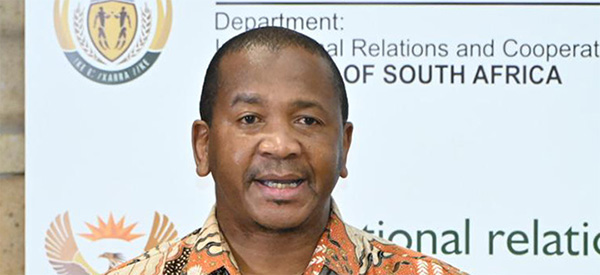
Ambassador Xolisa Mabhongo, Deputy Director-General: Global Governance and Continental Agenda at DIRCO
Quoting United Nations President, António Guterres, Mabhongo said: "Today we are witnessing assaults on the purposes and principles of the UN charter, an all too familiar pattern when states follow the charter when it suits them, but do not follow its rules when it does not."
Continuing, Mabhongo stated that the South African government has, on many occasions, warned that multilateralism is under attack and therefore needs to be defended and protected. "Recently," he said, "President Cyril Ramaphosa lamented this phenomenon when he said that these assaults on the UN reinforce the need to strengthen the multilateral system."
In addition, he quoted a caution from Guterres, stating: "When the law of power replaces the power of law, the consequences are deeply destabilising".
"Recent developments in the Middle East," said Mabhongo, "are examples of the might-is-right approach, in contrast to the decades of the applications of international law to curtail unchecked power, with the UN at the core of safeguarding an orderly system of multilateralism."
Concluding, Mabhongo said that because the assault on the UN is not a new occurrence, "the question we must ask ourselves is how we ensure that international law is optimal and works effectively. South Africa has always advocated an international system based on international law, with the UN at its centre. We believe that an international system based on fundamental legal principles of sovereign equality of states, territorial integrity and political independence, inherently benefits all nations, large and small."
In his keynote address, Ambassador Ebrahim Saley, non-resident Ambassador of the Republic of South Africa in Baghdad, briefly described the history of the Arab States of the Persian Gulf, including how colonisation shaped their modern interactions. Saley spoke about the resilience of Arab states after years of tensions and wars among them.
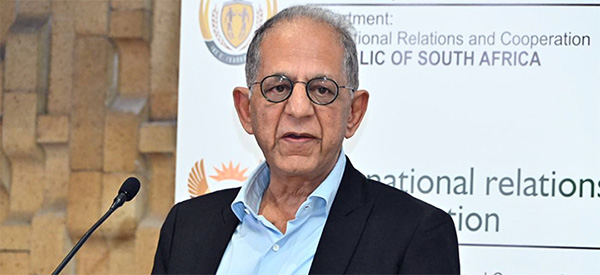
Keynote speaker, Ambassador Ebrahim Saley
Continuing, Saley also detailed the 1953 Iranian coup, backed by the United States and the United Kingdom, which overthrew the democratically elected Prime Minister Mohammad Mosaddegh over oil. "This coup saw the return of authoritarianism, which resulted in what we currently witnessed in Iran before the war," he said.
Concluding his address, Saley underscored the lasting impact of external interventions and colonialism, which he said have caused historical trauma in the Middle East.
An engaging discussion followed next, comprising panellists Jean-Nicolas Paquet-Rouleau, Head of Delegation: International Committee of the Red Cross Southern Africa, Prof Lee Stone, Department of Public, Constitutional and International Law, Unisa, Advocate André Stemmet, Retired Ambassador, and Joseph Dube, Institute of Disarmament and Arms Control. Their discussion focused on nuclear disarmament, the principles governing the International Criminal Court and the International Court of Justice, the war between the United States-Israel and Iran, the significance of the Strait of Hormuz in international trade, and diplomacy and peace, among other themes.
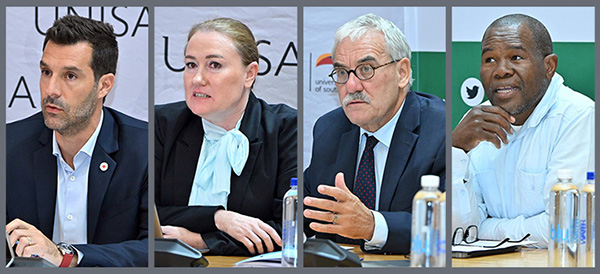
Panel discussants, from left: Jean-Nicolas Paquet-Rouleau, Head of Delegation: International Committee of the Red Cross Southern Africa; Prof Lee Stone, Department of Public, Constitutional and International Law, Unisa; Advocate André Stemmet, Retired Ambassador, DIRCO; and Joseph Dube, Institute of Disarmament and Arms Control
Unisa remains a university with its finger on the pulse of diplomacy, international relations and foreign policy. It provides platforms for dialogues on current social issues affecting humanity across the globe to find solutions that can influence policies and laws to end wars and conflicts.
* By Godfrey Madibane, Acting Journalist, Department of Institutional Advancement
** Photography by Shooheima Champion, Multimedia Centre
Publish date: 2026-04-09 00:00:00.0
 Unisa and NPC expand partnership to promote the journalism profession
 Unisa's renowned scholars nominated for South Africa's Science Oscars
 Unisa celebrates the life and legacy of Miriam Makeba
 Unisa seminar examines cultural knowledge and language as key ingredients of ubuntu
 Unisa on the global stage: Research excellence driving Africa's textile future