
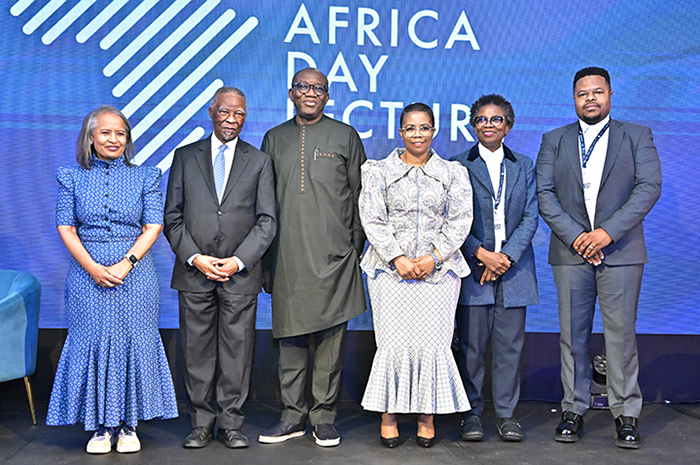
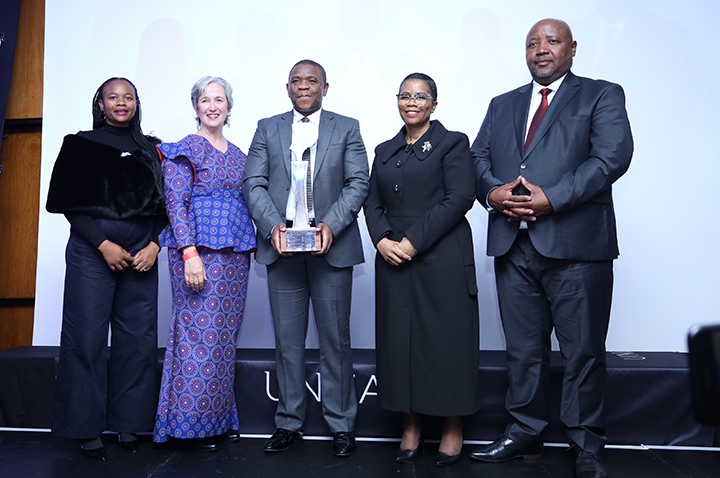
From left: Dr Geraldine Fraser-Moleketi, Chairperson of the Thabo Mbeki Foundation; Thabo Mbeki, Unisa Chancellor and Former President of South Africa; Dr Kayode Fayemi, keynote speaker and former Governor of Ekiti State, Nigeria; Prof Puleng LenkaBula, Unisa Principal and Vice-Chancellor; Prof Funmi Olonisakin, Vice-Principal, King’s College London; and Sakhile Mlauzi, Deputy Chairperson of the Unisa Council
To mark the pinnacle of a week-long Africa Day celebration, Unisa and the Thabo Mbeki Foundation (TMF) affirmed their leadership in Pan-African thought and dialogue by hosting the 16th Thabo Mbeki Africa Day Lecture under the theme "Rebuilding African Unity in an Age of Fragmentation: Sovereignty, Solidarity, and the Renewal of Institutions".
Held on 23 May 2026 at the Century City Conference Centre, Cape Town, the intellectual and public engagement made significant contributions towards advancing the African Union’s Agenda 2063.
To commemorate the founding of the Organisation of African Unity (OAU), now known as the African Union (AU), Africa Day is celebrated annually on 25 May. The observance serves as a platform for reflection and deliberation on Africa’s future. Notably, the Thabo Mbeki Africa Day Lecture series is at the forefront of this continental and global practice, fostering democratic governance and sustainable development on the continent.
In her welcome remarks, Prof Puleng LenkaBula, Unisa Principal and Vice-Chancellor (VC), acknowledged the presence of Thabo Mbeki, Unisa Chancellor and Former President of South Africa, the keynote speaker, Dr Kayode Fayemi, former Governor of Ekiti State, Nigeria, and Her Excellency, Malika Haddadi, Deputy Chairperson of the African Union (AU), who attended the proceedings virtually.
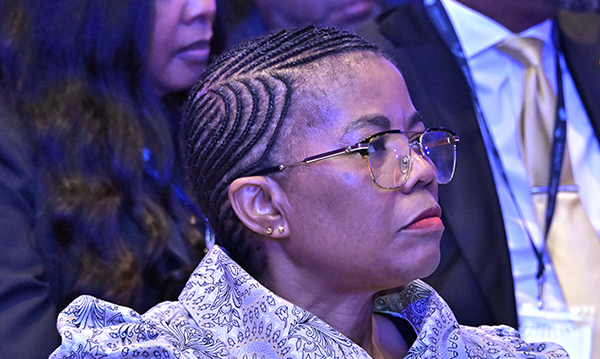
Prof Puleng LenkaBula, Unisa Principal and Vice-Chancellor
The VC also acknowledged the Chairperson of the TMF, diplomatic corps members from across the continent and the globe, members of parliament, members of Unisa’s executive management and Council, representatives from various South African universities, members of the legal fraternity, the Unisa Student Representative Council, programme participants and all guests.
The VC said that Unisa is delighted to work with the TMF to provide a global platform of engaged scholarship and activism for society. She added, "We know what it means for millions of Africans who look up to Pan-African institutions to facilitate dialogues, engagements, and critical discussions to reimagine the future".
Offering a message of support virtually, Haddadi indicated that the lecture’s theme aligns with the AU and Thabo Mbeki’s African Renaissance vision and is deeply rooted in Pan-Africanism. She implored African leaders to never lose sight of the importance of practising solidarity. "Solidarity must be consistent and predictable," she stated. Continuing, she reflected on a historic moment marking African unity, saying: "During the Covid-19 pandemic, African countries demonstrated solidarity through the African Vaccine Acquisition Trust and secured over 400 million doses of vaccine at a time when the global supply was uncertain. That was solidarity in action."
Concluding, Haddadi mentioned some of the challenges facing the continent, including infrastructure funding gaps and high transport costs, which remain among the biggest constraints to trade in Africa.
Delivering the keynote address, Fayemi lauded South Africa’s long and determined journey of liberation as a source of inspiration for millions of people across the continent and the world, whose democratic trajectory is deeply intertwined with Africa’s search for stable democratic development.
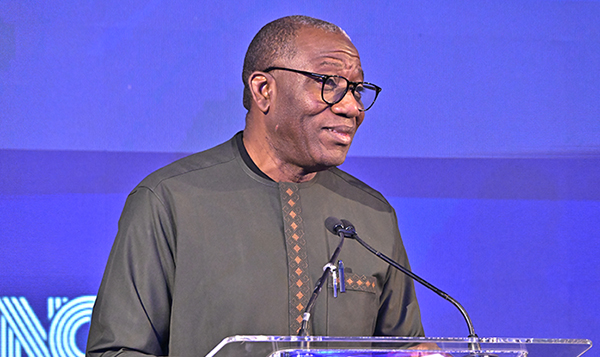
Dr Kayode Fayemi, keynote speaker and Former Governor of Ekiti State, Nigeria
Carrying on, Fayemi noted that the world is rapidly changing and argued that Africa has an opportunity to play a pivotal role in the global transition. "The international system is passing through imperial and profound uncertainty and restructuring," he added. "Across the world, multilateral institutions are under strain. Geopolitical rivalries are intensifying, economic nationalism is resurgent and global cooperation is becoming more fragmented."
He urged African countries to look beyond surviving the ongoing shifts and think about how to organise, with confidence, a collective spirit, courage and dignity to help shape the new global order.
"Africa's responsibility remains fundamentally to develop internal capacity for governance, businesses and citizens to engage the rest of the world from a position of self-assurance, long-term vision and clarity," he asserted.
Fayemi emphasised Africa’s enormous potential, highlighting its unmatched demographic strengths in entrepreneurial energy, cultural influence and strategic global relevance. "The world is increasingly recognising that the future of labour, energy transition, strategic minerals and even global markets will be deeply connected to Africans," he said. "In many of these areas, if you do not go Africa, you cannot go green."
Unpacking this year’s theme, Fayemi lamented the historical and current governance failures that have halted the continent’s progress, saying: "We are allegedly politically independent, yet often economically constrained; globally relevant, yet internally fragmented; resource-rich, yet bedevilled by poor leadership and institutional vulnerability." He declared that without solidarity, African societies become fragmented and susceptible to fear, mistrust, and division. Without strong institutions, neither sovereignty nor solidarity can be sustained over time.
While acknowledging the sacrifices made by men and women in the past to secure Africans' rights to govern themselves, Fayemi insisted that the world has changed significantly since the era of political independence, and that sovereignty cannot be narrowly understood in political and territorial terms alone.
He stressed that sovereignty requires productive capacity that can be achieved through interconnected economies, shared infrastructure, coordinated industrial policy, and strategic regional cooperation.
Reflecting on Africa’s positioning for its future, he posed what he deemed a difficult question: "Will Africa once again remain merely a source of raw materials for external industrial powers, will we continue to export wealth while importing poverty and dependence, or can this historical moment become the turning point through which Africa finally moves from extraction to structural transformation?"
"Africa must increasingly move from aid diplomacy to interest-based diplomacy," he said. "We must engage globally not merely as recipients of external assistance but as strategic anchors of shaping outcomes, and that ultimately requires institutional competence."
Fayemi expressed a longing for stable institutions, visionary leadership, strong universities, research institutions and policy centres, capable of generating African solutions to African challenges. "History demonstrates that societies do not simply collapse because they lack natural resources or talented citizens; nations fail when institutions become weak, hijacked, personalised and corrupted," he warned.
Continuing, Fayemi noted that African unity is achieved when Africans share emotional and historical consciousness, recognising that the destiny of African people remains interconnected. He further cited the contributions of African countries to South Africa’s liberation struggle, not as charity but with the Pan-African understanding that "oppression anywhere in Africa threatens dignity anywhere in Africa".
While acknowledging the factors fuelling xenophobic violence, such as economic inequality, unemployment, weak governance, poor service delivery, political manipulation and institutional distrust, he maintained that these issues must never legitimise violence or exclusion against fellow Africans.
Concluding, he said: "The limitations of our past will not determine the future of Africa, but by the quality of our choices we make in this moment. Sovereignty without visionary leadership and institutional capacity is fragile. Unity without solidarity is hollow. And development without accountable governance is unsustainable."
The week-long Africa Day celebrations will conclude on Monday 25 May, with a post-lecture student town hall, where young people will be engaged on issues facing the continent.
Read also:
Unisa hosts high-profile business breakfast in buildup to Africa Day Lecture
* By Victor Malatji, Journalist Intern, Department of Institutional Advancement
** Photography by Shooheima Champion, Multimedia Centre
Publish date: 2026-05-24 00:00:00.0
 Seeing beyond the horizon: Unisa shapes tomorrow as it expands its research outputs significantly
 Yet another PRC success story
 Unisa alumna shines with agricultural technology solution
 Unisa and the NPC celebrate impactful media contributions
 Unisa project empowers the community through digital skills training