

The largest provider of business education in Africa and one of the largest in the world
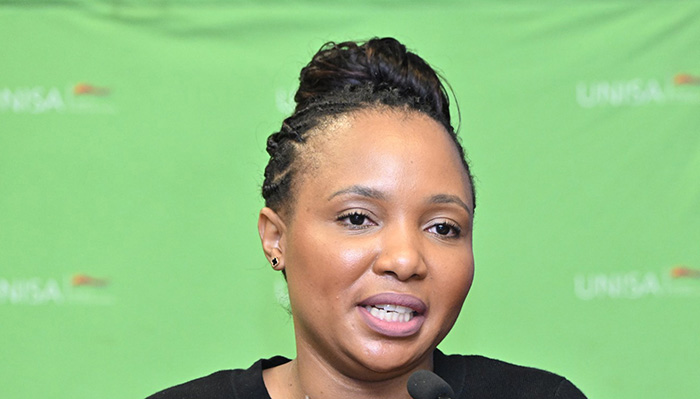
Mpho Molopyane, Chief Economist at Alexforbes, delivered the keynote address
Unisa, through its College of Accounting Sciences (CAS) and College of Economic and Management Sciences (CEMS), recently hosted the Eighth Annual Post-Budget Dialogue at the Muckleneuk Campus under the theme "From G20 Leadership to 2030: Using Fiscal Policy as a Catalyst for South Africa’s Sustainable Transformation".
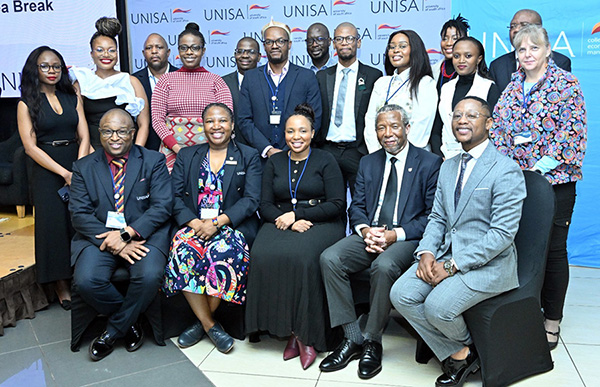
Members of Unisa’s executive management, staff and panellists
Delivering the welcome address on behalf of Prof Puleng LenkaBula, Unisa Principal and Vice-Chancellor, Prof Solomon Magano, Vice-Principal: Institutional Advancement, highlighted the importance of national budgets in shaping development priorities.
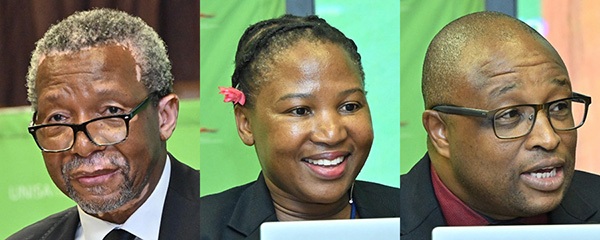
From left: Prof Solomon Magano, Dr Mantepu MaseTshaba and Dr Moses Hlongwane
"South Africa’s national budget is far more than a financial document; it is a statement of national priorities that reveals the future we are choosing to build," he said.
The dialogue brought together academics, policymakers, economists and industry experts to reflect on the 2026 National Budget and its implications for South Africa’s fiscal trajectory.
"The 2026 Budget arrives at a critical moment for South Africa’s public finances," noted Magano. "Encouraging signals such as debt stabilisation and renewed fiscal discipline provide an opportunity to reposition fiscal policy for long-term transformation."
The event featured a context-setting keynote address by Mpho Molopyane, Chief Economist at Alexforbes, titled "Budgeting for Long-Term Transformation". In her address, she reflected on the broader fiscal context shaping the 2026 Budget. "The 2026 budget has been characterised as a major turning point for fiscal policy," she said, noting that South Africa must strengthen its domestic economic foundations in a complex global environment.
"It’s very important for South Africa to start creating its own tailwinds and not rely on the global economy," she added.
A key theme of the budget is the stabilisation of South Africa’s debt-to-GDP ratio, which Treasury projects will stabilise in the current fiscal year after several years of increases. Molopyane emphasised that the challenge is not necessarily debt itself, but the cost of servicing it. "It’s not so much the problem of debt but rather how much you pay to service that debt," she said.
The programme also featured two dialogue sessions focusing on key fiscal policy priorities:
Delivering the synthesis of key messages and way forward, Dr Mantepu MaseTshaba, Acting Executive Dean of CEMS, reflected on the importance of collaborative dialogue between academia, policymakers and industry in shaping South Africa’s fiscal future.
The event concluded with a vote of thanks delivered by Dr Moses Hlongwane, Executive Dean of CAS, who acknowledged the contributions of the speakers, panellists, and participants.
* By Tebogo Mahlaela, Communication and Marketing Specialist, College of Economic and Management Sciences
Publish date: 2026-03-12 00:00:00.0
 Wearing her achievement with pride
 Unisa shines as four academics reach the finals of South Africa's prestigious 'Science Oscars'
 Breaking barriers through RPL
 Why Generation Z is choosing Unisa for flexible learning
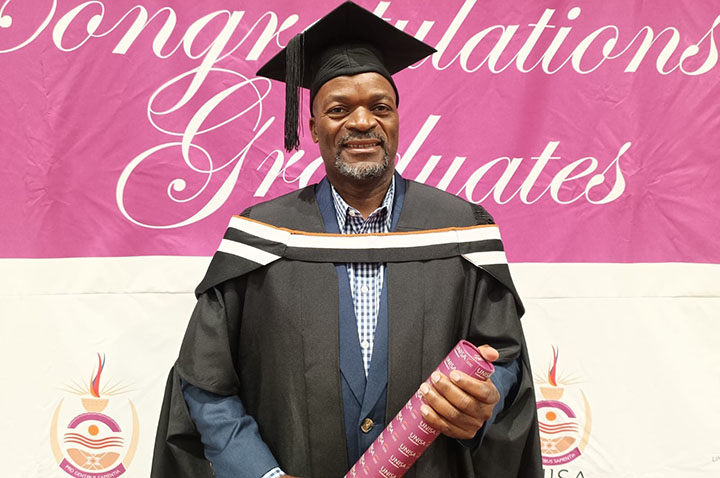 The long run to leadership: an MBL graduate's story of grit and achievement