Student Funding: bursaries & loans
NSFAS funding
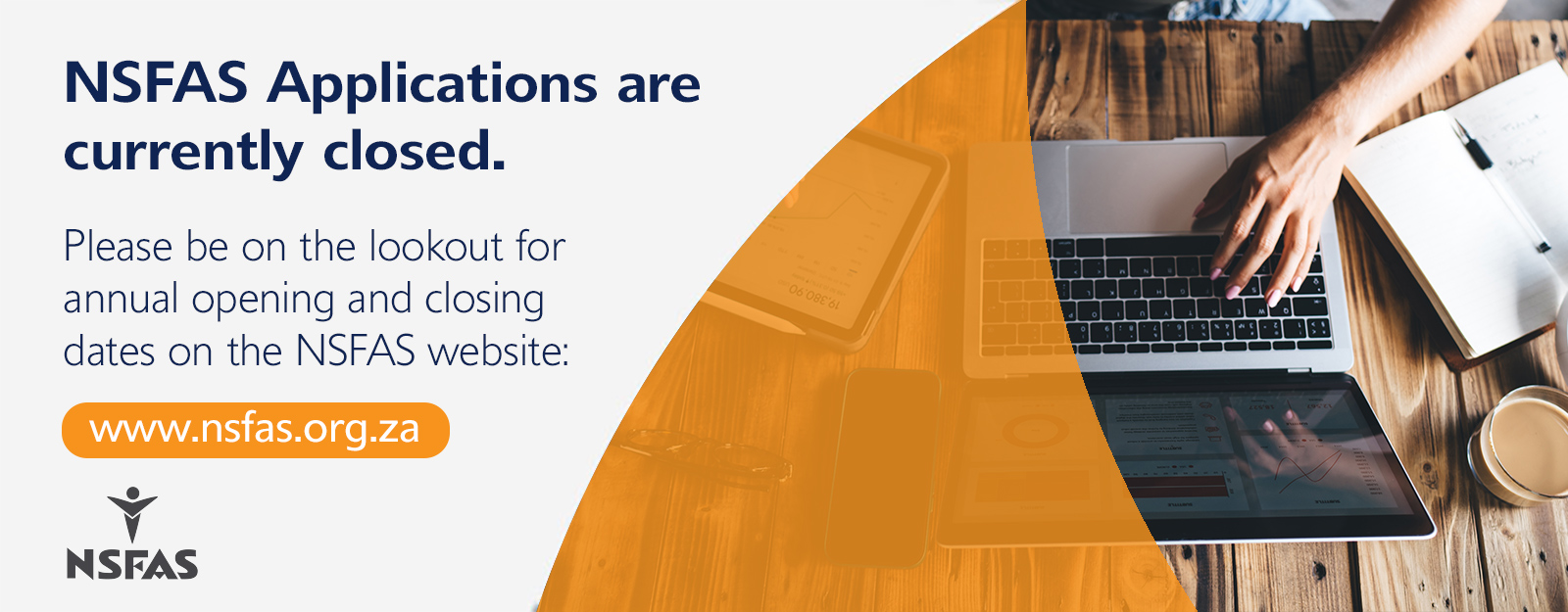
What Does NSFAS Cover
NSFAS funding covers the costs of studying at a public university or TVET college. Where a student qualifies and is funded at UNISA, NSFAS pays the following directly to the institution or to the student:
- Registration and tuition fees, paid directly to the institution.
- A living/personal care allowance.
- A learning materials allowance for books or other stationery.
NSFAS does not cover certain costs, including historic debt, student card fees, library fines, and fees for re-examinations or supplementary exams. Students remain personally responsible for these costs.
Who Qualifies for Funding
To qualify for NSFAS funding, you need to meet the following requirements:
- Be a South African citizen or permanent resident.
- Be registered, or intending to register, for an approved qualification at a public university or TVET college.
- Come from a household with a combined gross annual income that does not exceed the NSFAS threshold of R350,000 per year
- Returning students must also meet the academic progression requirements set by their institution and NSFAS, including the N+ rule, to continue receiving funding.
Important Notice
Funding can be revoked even after finalisation of your registration, leaving you liable for your tuition fees and repayment of allowances if you are later found to:
- Exceed the N+ rule or academic progression requirements.
- Exceed the household income threshold.
- Have submitted false, incomplete, or fraudulent information or documentation.
- No longer meet the enrolment requirements. (E,g duplicate registration, switching qualifications mid-year, enrolling at an incorrect institution not in accordance with your funding etc.)
The N+ Rule
The N+ rule determines the maximum length of time NSFAS will fund a student for a qualification. "N" refers to the minimum number of years required to complete the qualification, and the additional year(s) allowed for academic setbacks.
Every year a student is registered counts toward the N+ calculation, irrespective of if modules were passed or not, and if NSFAS funded that particular year or not.
Once a student exceeds their N+ limit, NSFAS funding may be revoked, and the student becomes responsible for their own fees.
Appealing A Rejection
Appeals are submitted through the myNSFAS portal within the timelines communicated by NSFAS
Common reasons for a successful appeal include serious illness lasting two months or more, a death in the immediate family, being the victim of a violent crime, or pregnancy and childbirth during the academic term.
Supporting documentation, such as a medical certificate or death certificate, must accompany the appeal.
NSFAS reserves the right to validate all appeal documentation.
NSFAS FAQs
What if I have an existing myNSFAS account but I have forgotten my old username, password and cell phone number. How do I reset my profile?
Follow the steps below to reset your myNSFAS login details:
STEP 1 – Go to: www.nsfas.org.za , click on NSFAS funding and then click on ‘forgot password’
STEP 2 - Type in your ID number and choose what you require help with: password or username or both and then click on ‘submit’.
STEP 3 - The username and the link to change your password will be sent via SMS and email.
STEP 4 - Open the link and you’ll be redirected to the reset password page.
STEP 5 - Reset your password by following the prompts on your screen.
If your NSFAS application for 2026 was rejected, you can appeal within 30 days by submitting relevant documents through the myNSFAS portal.
Steps to Appeal Your NSFAS Application
- Log into Your myNSFAS Account: Access your account to check your application status and the specific reason for rejection.
- Submit Your Appeal: Click on the “Submit Appeal” option. Ensure that you do this within 30 days of receiving your rejection notification.
- Include Required Documents: Your appeal must include supporting documents that address the reason for your rejection.
Common documents include:
- Proof of changed financial circumstances (e.g., retrenchment letter, death certificate).
- Medical reports if your academic performance was affected by illness.
- Any other relevant documentation that supports your case.
Who Can Appeal?
You can appeal if:
- Your application was rejected due to exceeding the income threshold.
- You did not meet academic requirements.
- You failed to submit all required documents or submitted incorrect ones.
Important Considerations
- Deadline: Appeals must be submitted within 30 days of the rejection notice. Late appeals will not be considered.
- No Fees: There are no fees associated with submitting an appeal.
- Review Process: After submission, NSFAS will review your appeal. You can track the status of your appeal through your myNSFAS account.
Refund Process
A refund may apply where a funded student, or an institution paid on the student's behalf.
- Refunds often commence in the following year, after the registration period
- Refunds under 10K are processed automatically. Initiation from the student is not required.
- Refunds over 10k require a refund form which is sent by a refund’s administrator to each student. Therefore, no initiation by the student is required
- Refunds will only be released to the student once NSFAS has paid the institution the full cost for the year the refund was paid
Funding process for the student ’’Eligible for funding’’
- NSFAS assesses the application and confirms the student as eligible for funding.
- NSFAS communicates the funding decision to the institution.
- The institution activates the student’s registration upon receipt of funding confirmation.
- NSFAS covers the approved costs for the current academic year in line with NSFAS rules.
- Institution submits the claim to NSFAS and the student status changes to registration received on the portal (reflect the Institution name that submitted the claim).
- Tuition and registration fees are settled directly with the institution.
- Student allowances (where applicable) are disbursed according to NSFAS allowance guidelines.
- Any outstanding historical debt not covered by NSFAS remains the responsibility of the student.
Important to note
Funding outcomes will be communicated via your myNSFAS portal. Please note that UNISA will also receive communications of funded students.
Important Reminders
- Only apply through the official NSFAS website or the myNSFAS portal.
- Keep your contact and banking details up to date to avoid delays with allowances or refunds.
- Meeting academic progression requirements each year is essential to keep your funding active.
- Respond promptly to any request for documentation, as incomplete submissions are a common cause of delays and rejections.
- Be cautious of scams. UNISA will never ask for payment or personal banking details through unofficial channels or social media accounts.
- Familiarise yourself with your bursary guidelines, and terms and conditions.
Other NSFAS Administered Bursaries
Students funded under the following bursaries must renew their funding directly with their funder during the applicable application windows. Visit each funder's website for more information:
- Funza Lushaka: www.funzalushaka.doe.gov.za
- Department of Military Veterans (DMV): www.dmv.gov.za
- Department of Justice (TRC): www.justice.gov.za
- Compensation for Occupational Injuries and Diseases (COID): www.labour.gov.za
NSFAS Contact Details
NSFAS Virtual Contact Centre:
- Toll-free: 0800 067 327
- General enquiries email: info@nsfas.org.za
- Payments and balance enquiries email: collections@nsfas.org.za
- WhatsApp: +27 63 093 5671
- USSD: *120*67327#
- Fraud and ethics hotline email: speakup@nsfas.org.za
- Physical address: The Halyard, 4 Christiaan Barnard Street, Cape Town City Centre, Cape Town, 8001
Students can also check their application/appeal status through the myNSFAS portal at my.nsfas.org.za
Last modified: 2026/08/25