News & Events
Unisa takes Global South debate to the heart of internationalisation
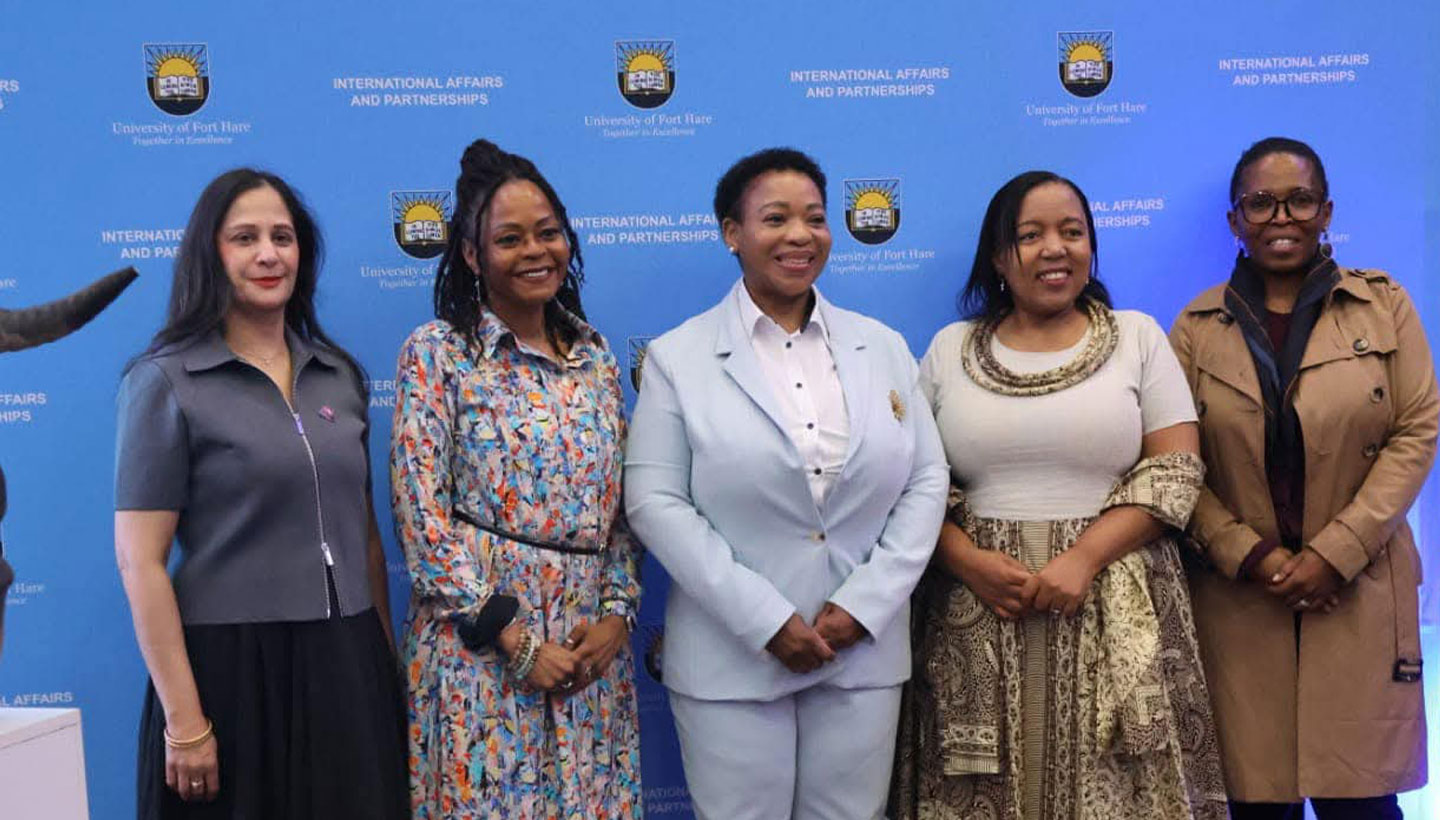
L-R: Dr Tasmeera Singh, Deputy President of IEASA and Director of International Relations and SANORD at the University of the Western Cape; Dr Normah Zondo, President of IEASA and Executive Director of the Corporate Relations Division at the University of KwaZulu-Natal; Dr Nomusa Dube-Ncube, Deputy Minister of Higher Education and Training; Dr. Nthabi Taole-Mjimba, Acting Vice-Chancellor, University of Fort Hare; and Dr Angie Magabane, Director of Internationalisation and Partnerships in the Department of Institutional Advancement at UNISA, and Treasurer of IEASA
For four days, the future of higher education internationalisation was debated in kuGompo City, but the conversation was not simply about sending students abroad or signing international partnerships.
It was about who gets to shape the global higher education agenda, whose realities are reflected in it, and how universities in the Global South can build meaningful connections with the rest of the world.
That conversation placed the University of South Africa (Unisa) firmly in the spotlight at the 28th Annual Conference of the International Education Association of South Africa (IEASA), held at the East London International Convention Centre from 25 to 28 August 2026.
Unisa was represented by a strong delegation led by Dr Angie Magabane, Director of Internationalisation and Partnerships in the Department of Institutional Advancement. Magabane also serves as Treasurer of IEASA.
Held under the theme “Rewriting the Agenda: Internationalisation Through a Global South Lens,” the conference brought together vice-chancellors, senior international officers, academics and postgraduate students from South Africa and abroad to examine how internationalisation can become more equitable, relevant and responsive to the realities of the Global South.
The conference was formally opened by Dr Nomusa Dube-Ncube, Deputy Minister of Higher Education and Training, who called for a more deliberate approach to internationalisation.
In her keynote address, Dube-Ncube said internationalisation should be intentional and aligned with the developmental priorities of higher education institutions. She emphasised that meaningful internationalisation should strengthen universities, expand opportunities for students and contribute to the professional growth of academic staff.
She also highlighted the importance of international partnerships in building research capacity, stimulating innovation and creating collaborations that deliver tangible social and economic benefits for South Africa and the continent.
For Unisa’s postgraduate students, the engagement began on the first day with a series of workshops exploring emerging issues in internationalisation, including the evolving roles and challenges facing Senior International Officers.
The wider programme featured prominent voices in higher education, including Dr Tasmeera Singh, Deputy President of IEASA and Director of International Relations and SANORD at the University of the Western Cape, who delivered the opening and strategic framing address.
Dr Normah Zondo, President of IEASA and Executive Director of the Corporate Relations Division at the University of KwaZulu-Natal, delivered the presidential address and official welcome.

UNISA-SASUF Student Network Interim Committee
Prof Jonathan Jansen, Distinguished Professor at Stellenbosch University, delivered a keynote titled “Internationalisation Meets Academic Xenophobia: Institutional Ambitions and the New Geopolitics of Higher Education.”
The conference also saw the official launch of the Study South Africa Guide 2026, which showcases Unisa alongside other South African universities.
As IEASA Treasurer, Magabane played a prominent role in the conference programme, delivering the Opening Reflections on the second day.
Her remarks drew together key themes emerging from the discussions while underscoring the importance of collective leadership, collaboration and sustained engagement in advancing the internationalisation of higher education.
Her role also highlighted Unisa’s growing visibility within South Africa’s internationalisation community and the university’s contribution to shaping strategic conversations around the future of global engagement in higher education.
But some of the most interesting contributions came from the students and young professionals accompanying the delegation.
A notable part of the Unisa contingent was the South Africa-Sweden University Forum (SASUF) Student Network Forum Committee, comprising Siyabonga Seme, National Convenor; Irma Thema, Secretary-General; Stanley Huma, Student Engagement Officer; Stanley Namakhota, International Relations; Mmangakane Mmako, Communication and Marketing Officer; Ronald Mulaudzi, Digital Platforms and ICT; and Gloria Makhuza, Research Coordinator.
Their participation reflected Unisa’s continued investment in student-driven internationalisation through the SASUF partnership, while allowing postgraduate students to engage directly with sector leaders and international perspectives on the future of higher education.
For the students, the conference was not simply an academic exercise. It raised practical questions about how internationalisation can translate into opportunities students can actually experience.
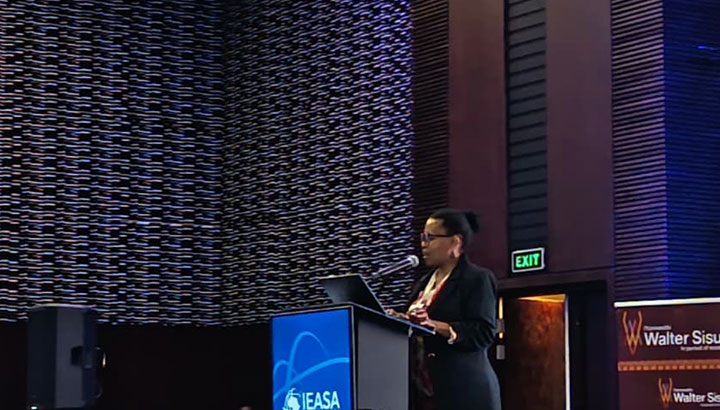
Dr Magabane, addressing the conference on the second day, where she was reflecting on the first day of the conference
Unisa PhD student Mbalenhle Chidi said the conference had changed the way she viewed the relationship between technology and international engagement.
The event, she said, “deepened my understanding of how AI and technology can drive collaborative internationalisation, strengthening ties between South African scholars and the world.”
Mmangakane Mmako, Communication and Marketing Officer, focused on the people who must ultimately drive internationalisation within universities.
Institutions of higher learning should “strengthen investment in the empowerment and skills development of staff and registered students to build a strong internationalisation culture,” she said.
For Ronald Mulaudzi, responsible for Digital Platforms and ICT, one of the most significant discussions centred on Collaborative Online International Learning (COIL), which allows students and academics in different countries to collaborate virtually.
“Looking at Unisa’s footprint, we can embed COIL through a virtual platform and consider creating global classrooms through partnerships with international universities. This may help our students gain exposure to different cultures and develop global awareness,” Mulaudzi said.
The idea has particular relevance for Unisa, whose distance-learning model already connects students across geographical boundaries and could provide a foundation for expanding virtual international collaboration.
Stanley Namakhota, who works in International Relations, highlighted another important dimension of the discussions: the need to ensure that internationalisation does not leave international students behind.
He described the conference as being about “empowering international students through student support initiatives.”
By the time the conference closed on Friday, 28 August, the discussions had moved beyond the traditional understanding of internationalisation as a collection of exchange programmes, agreements and overseas visits.
For the Unisa delegation, the conference opened a broader conversation about technology, student participation, staff development, research collaboration, inclusion and the role African universities can play in defining the future of global higher education.
Unisa’s participation also demonstrated how internationalisation can be connected to the university’s broader mission of developing people, expanding knowledge and strengthening Africa’s contribution to global conversations.
Through initiatives such as SASUF and its engagement with IEASA, Unisa continues to position its staff and students to participate in these conversations, while seeking practical ways to translate international partnerships into meaningful opportunities.
In doing so, the university is working towards its ambition of remaining the African University in the service of humanity.
* By Siyabonga Seme, Unisa-SASUF National Convenor
Publish date: 2026-08-28 00:00:00.0