News & Events
Unisa explores solutions to youth unemployment
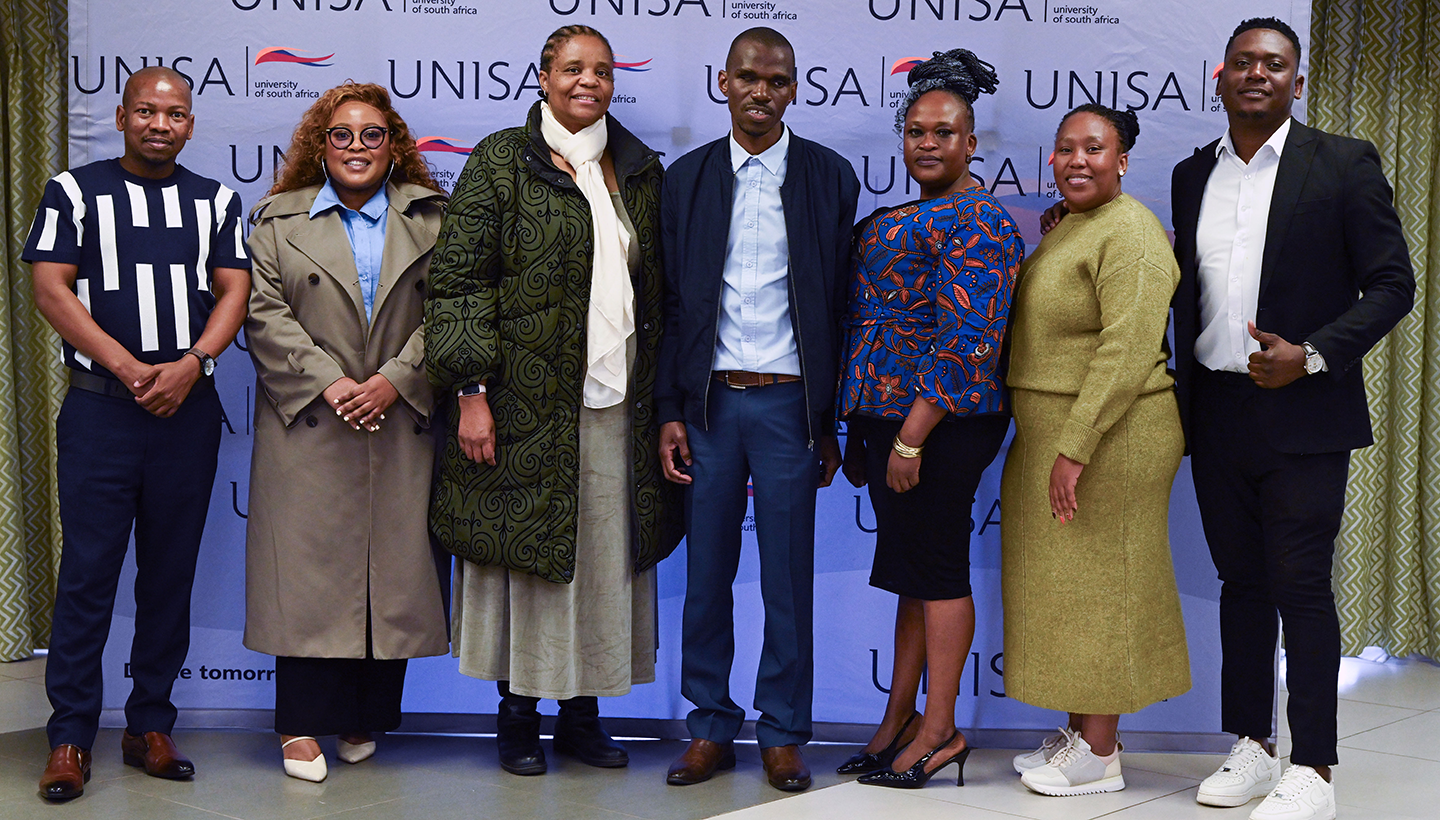
From left, Dr Zethembe Mseleku, Nomfundo Khumalo, Prof Grace Khunou, Thakani Masuka, Emma ka Mbele, Badumisile Hlongwane, and Dr Light Ubisi
As South Africa continues to grapple with persistently high youth unemployment, the University of South Africa (Unisa) has reaffirmed the importance of internships, learnerships and collaborative partnerships in preparing graduates for the world of work.
Unisa’s Department of Leadership and Transformation hosted a seminar titled Learnerships and Internships: Bridging Graduate and Youth Unemployment at the Protea Restaurant in the OR Tambo Building on the university’s Tshwane Campus.
The seminar brought together academics, industry leaders, government representatives, students and young professionals to discuss practical and sustainable solutions to one of South Africa’s most pressing socio-economic challenges.
Discussions centred on strengthening graduate employability through workplace learning, strategic partnerships and transformative leadership. Speakers agreed that while higher education remains critical, graduates also need practical experience, mentorship and stronger links between universities, government and industry to improve their employment prospects.
The seminar also reflected on national efforts to combat youth unemployment. Through partnerships involving government, Sector Education and Training Authorities (SETAs), the National Skills Fund (NSF), higher education institutions and the private sector, internship and learnership programmes have been expanded to equip graduates with workplace skills and ease the transition from university into employment.
The discussions aligned with the objectives of South Africa’s National Development Plan (NDP) 2030, which identifies education, skills development and job creation as key drivers of reducing poverty, inequality and unemployment.
Delivering the opening address, Professor Grace Khunou, Executive Director of Unisa’s Department of Leadership and Transformation, said internships and learnerships should be viewed as opportunities to develop professional skills rather than permanent employment.
She said universities have a responsibility not only to produce graduates but also to help address inequality by preparing students for meaningful participation in the economy.
“Universities exist not only to remain relevant but also to help close inequality gaps,” Khunou said.
She encouraged graduates to embrace continuous learning and to view mistakes as opportunities for growth rather than failure.
Khunou also praised four interns from her department who planned and coordinated the seminar, saying the responsibility formed part of their own professional development.
“We deliberately entrusted them with organising this seminar so they could experience accountability, strengthen their leadership abilities and develop workplace competence,” she said.
She added that, as Africa’s largest open distance learning institution and a major employer, Unisa has an important role to play in developing graduates and contributing to national conversations on unemployment and social inequality.
Opening the first panel discussion, Dr Zethembe Mseleku, a senior lecturer at the University of KwaZulu-Natal, reflected on his own experience as an intern, describing it as both humbling and life-changing.
Drawing from his personal journey, Mseleku said internships provide far more than work experience. They also help young professionals build resilience, confidence and adaptability.
He examined the structural causes of unemployment and their wider social impact, noting that government and other stakeholders have introduced several initiatives to improve youth employment. These include expanding access to higher education, supporting youth entrepreneurship and increasing internship opportunities.
According to Mseleku, the challenge is no longer whether interventions exist, but whether they are being implemented effectively and reaching the graduates who need them most.
He also challenged the common belief that a university qualification is “just a piece of paper”.
While acknowledging that a qualification does not guarantee employment, he argued that higher education continues to improve a graduate’s chances of securing work compared with those who do not have post-school qualifications.
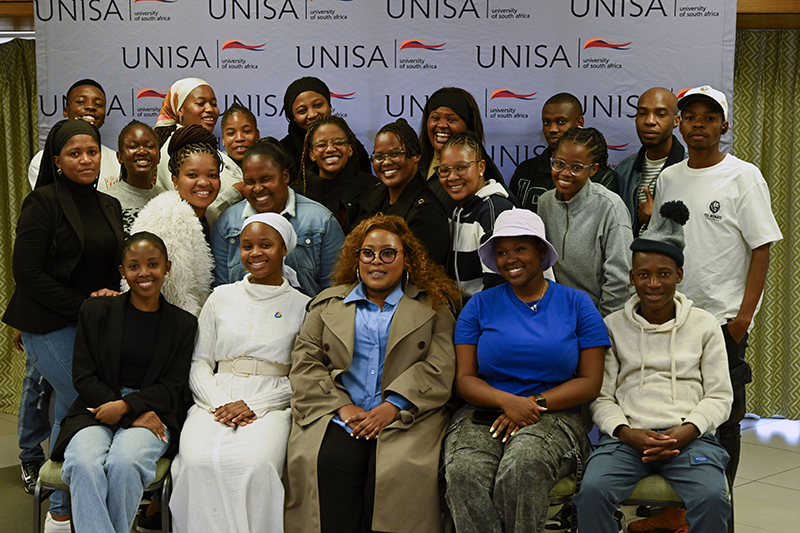
Regional Student Representative Council Chairperson, Nomfundo Khumalo, with Unisa graduates
Regional Student Representative Council Chairperson Nomfundo Khumalo welcomed the university’s decision to include young people in discussions about graduate unemployment.
She reminded delegates that behind every unemployment statistic is a real person whose education often represents years of sacrifice by both the student and their family.
“Behind every unemployed graduate is someone who studied despite financial hardship, a family that sacrificed to support that person’s education and a graduate questioning whether their qualification still has value,” she said.
Khumalo argued that internship stipends often fail to meet the financial realities facing graduates and called for stronger protections to ensure internships provide meaningful learning opportunities rather than routine administrative work.
She said many interns spend their time making tea, photocopying documents, and performing other basic tasks, rather than gaining practical experience that contributes to their professional development.
Emma ka Mbele from Services SETA provided historical context on the evolution of learnerships and internships in South Africa, explaining how workplace learning has become an essential component of graduate development.
She encouraged graduates to register with relevant professional bodies, where applicable, noting that professional recognition can strengthen long-term career prospects.
Ka Mbele also reminded participants that internship stipends are intended as developmental support during workplace training rather than permanent salaries.
Adding to the discussion, Dr Light Ubisi, a lecturer in Public Administration at Unisa, encouraged graduates to continue studying while completing internships.
Reflecting on his own career journey, Ubisi urged young people to pursue bursaries and international study opportunities, saying global exposure can broaden career options and enhance professional competitiveness.
Thakani Masuka from Unisa’s Directorate of Employment Equity highlighted the additional barriers faced by graduates living with disabilities.
Speaking from personal experience as a visually impaired professional, Masuka said internships and learnerships can only become truly transformative when institutions commit to inclusive policies, accessible workplaces and adequate support systems.
He stressed that graduates with disabilities should have equal access to opportunities that enable them to develop their skills and participate fully in the labour market.
Throughout the seminar, participants emphasised that tackling youth unemployment requires a collective effort involving universities, government, industry and civil society.
The discussions reinforced Unisa’s commitment to producing graduates who are not only academically qualified but also equipped with the practical skills, confidence and professional networks needed to succeed in an increasingly competitive labour market.
For many graduates and interns who attended, the seminar offered more than policy discussions. It provided practical advice, networking opportunities and renewed encouragement that, despite the country’s unemployment challenges, meaningful pathways into the workplace can be created through collaboration, innovation and sustained investment in graduate development.
* By Lesego Chiloane, Journalist, Department of Institutional Advancement
** Photography: Tshegofatso Kupa, Multimedia Centre
Publish date: 2026-07-17 00:00:00.0