News & Events
Perseverance pays off for visually impaired student
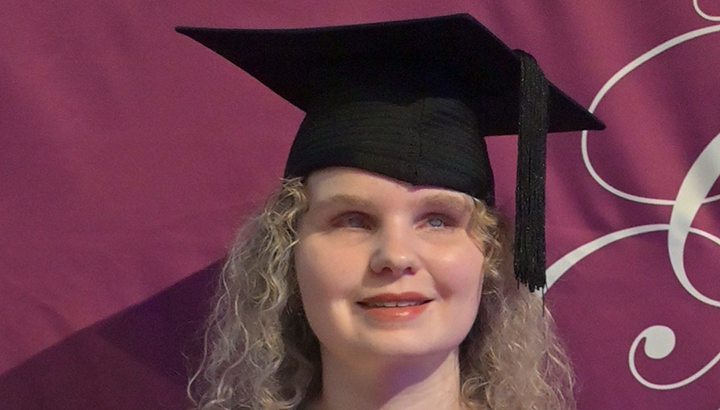
Proud graduate Robyn Waters
Twenty-five-year-old Robyn Waters recently graduated with a Bachelor of Arts in Creative Writing, an impressive and inspiring achievement for anyone, but especially remarkable given that she was born with microphthalmia and has been blind since birth.
Following her instincts
The idea of pursuing a degree in creative writing first took root during the COVID-19 pandemic. Waters describes herself as an imaginative person with a passion for reading. “Storytelling has been my way of understanding the human mind, as well as an escape from a mostly isolated life because of my disability,” she explains.
Before the pandemic, she studied music and was preparing to complete her Trinity Grade 8 examination. As a trained operatic singer, her original plan was to continue her music studies in London. “During the pandemic, I realised that wasn’t what I truly wanted,” she says. “Lockdown provided me a chance to catch my breath and to find a clear perspective. Writing was a comfort to me during this time, so I decided to change course.”
“Unisa was the right fit for me”
The decision to study at Unisa was an easy one for Waters. She credits the university’s strong support for students living with disabilities as one of the deciding factors. “Studying online meant I was able to work at my own pace,” she says. The assistance provided by the Advocacy and Resource Centre for Students with Disabilities (ARCSWiD) proved invaluable. “I am grateful to have been able to receive my study guides already converted into the formats that are compatible with my tablet.” She also appreciates the subsidy she received for prescribed books and the extra time arranged for her examinations.
The courage to take it one step at a time
“As clichéd as it might sound, perseverance and courage are key at all times. Where there is a will, there is a way,” says Waters when reflecting on what motivated her to complete her degree. “Courage is essential to take action, to get started, to do the application, then the first assignment and each exam,” she says.
She highlights the importance of having a support system and the courage to ask for help when needed, saying, “Trust me, rather than furthering or proving your independence, being too proud to ask for help, particularly during exam time, will only hinder it.” She acknowledges that students with disabilities might be particularly tempted to give up and drop out, and she faced that same challenge. However, she encourages others to remember why they started in the first place. “In my case, it was intensely rewarding to stand on stage and receive my degree, knowing that all my prayers, all my tears and that one assignment I had to complete while I was sick as a dog somehow paid off,” she concludes. “Disability, or any challenge for that matter, cannot and will not be a hindrance unless you allow it to be.”
* By Vicky-Lee Lee Shew, Corporate Communications and Marketing, Western Cape Region
Publish date: 2025-12-12 00:00:00.0