News & Events
AMT to strengthen global black hole imaging and advance African astrophysics

The partnership between the University of South Africa (Unisa) and the University of Namibia (UNAM) to advance the Africa Millimetre Telescope (AMT) project, the first of its kind in Southern Africa, positions the two institutions at the forefront of gamma-ray astronomy and millimetre-wave black hole imaging, and provides young researchers with world-class opportunities.
On 24 and 25 February 2026, Unisa Principal and Vice-Chancellor, Professor Puleng LenkaBula, accompanied by senior management, academics and student researchers in astrophysics, and professional staff, engaged with UNAM Vice-Chancellor, Professor Kenneth Matengu, to affirm a joint commitment to advancing African-led astronomy research infrastructure, including the AMT project, fostering postgraduate development, and deepening long-term scientific collaboration.
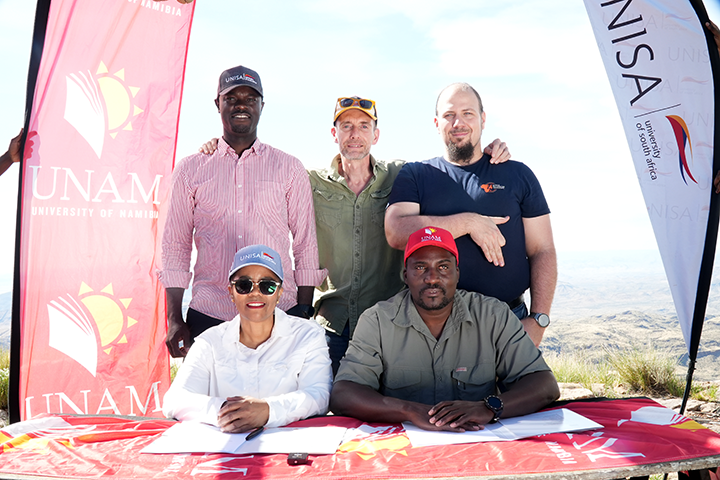
Front, from left: Prof Puleng LenkaBula, Unisa Principal and Vice-Chancellor and Professor Kenneth Matengu, UNAM Vice-Chancellor
Back, from left: Prof James Chibueze, Distinguished Professor: Centre for Astrophysics and Space Sciences, Unisa, Prof Marc Klein Wolt, Project Director: Africa Millimetre Telescope, and Prof Michael Backes, Research Chair in Astronomy and Head of the Namibian H.E.S.S. Group, UNAM
The AMT, to be constructed on Gamsberg in Namibia’s Khomas Highlands, represents a transformative step in Africa’s contribution to global frontier astrophysics.
The AMT will be a next-generation 14-metre radio telescope operating at millimetre wavelengths. Once operational, it will become a critical component of the global Event Horizon Telescope (EHT) network — the international collaboration that produced the first-ever image of a black hole in 2019.
By expanding coverage in the Southern Hemisphere, the AMT will significantly enhance the EHT network's imaging resolution and time-sensitive observational capacity.
Professor Marc Klein Wolt, Project Director of the AMT, explains the telescope’s global importance: “The AMT fills a crucial geographic gap in the Event Horizon Telescope array. By placing a millimetre-wave telescope in Southern Africa, we dramatically improve the network’s imaging capability. This is a global scientific advancement made possible through African partnership and leadership.”
Why Gamsberg?
The AMT is being developed near the existing High Energy Stereoscopic System (H.E.S.S.). This world-class gamma-ray observatory studies the most energetic phenomena in the universe, including supernova remnants, pulsars and regions around black holes.
H.E.S.S. detects extremely high-energy gamma rays using multiple telescopes operating together through stereoscopic imaging. These observations allow scientists to trace how cosmic particles are accelerated to near-light speeds.
Professor Michael Backes, Research Chair in Astronomy and Head of the Namibian H.E.S.S. Group at UNAM, emphasises the scientific synergy: “H.E.S.S. explores the universe’s most energetic explosions. The AMT will sharpen our view of black holes at millimetre wavelengths. Together, these facilities strengthen Namibia’s standing as one of the most scientifically strategic astronomy sites globally.”
Namibia’s unique observing conditions, high altitude, exceptionally dry air and minimal light and radio interference make it one of the best astronomy locations in the world.
Advancing black hole science
The EHT operates as a global array of radio telescopes connected through very-long-baseline interferometry, effectively creating an Earth-sized virtual telescope. Adding the AMT enhances Southern Hemisphere coverage, enabling more precise and dynamic imaging of supermassive black holes.
Professor James Chibueze, Distinguished Professor at Unisa’s Centre for Astrophysics and Space Sciences, underscores the scientific and developmental impact, “The AMT strengthens Africa’s role within the Event Horizon Telescope network while building technical expertise on the continent. It ensures that African researchers are contributing directly to high-impact discoveries in black hole physics and astrophysics.”
The collaboration between Unisa and UNAM reflects a shared investment in African-led research infrastructure, postgraduate development and technical skills transfer. With foundational financial support and long-term scientific cooperation, the agreement positions South Africa and Namibia at the forefront of millimetre astronomy.
Building Africa’s astronomy ecosystem
The proximity of the AMT to H.E.S.S. reinforces a growing astronomy ecosystem in Southern Africa, spanning gamma-ray astronomy to millimetre-wave black hole imaging.
From studying the universe’s most energetic explosions to capturing the shadow of a black hole, these instruments collectively advance the science of the extreme universe.
As Wolt notes, “Africa is not simply hosting infrastructure; it is shaping the future of global astrophysics.”
From gamma rays to black holes, Southern Africa is strengthening its role in frontier science, ensuring that African researchers are not only observing global discoveries but actively leading them.
A world-class opportunity for young Southern African researchers
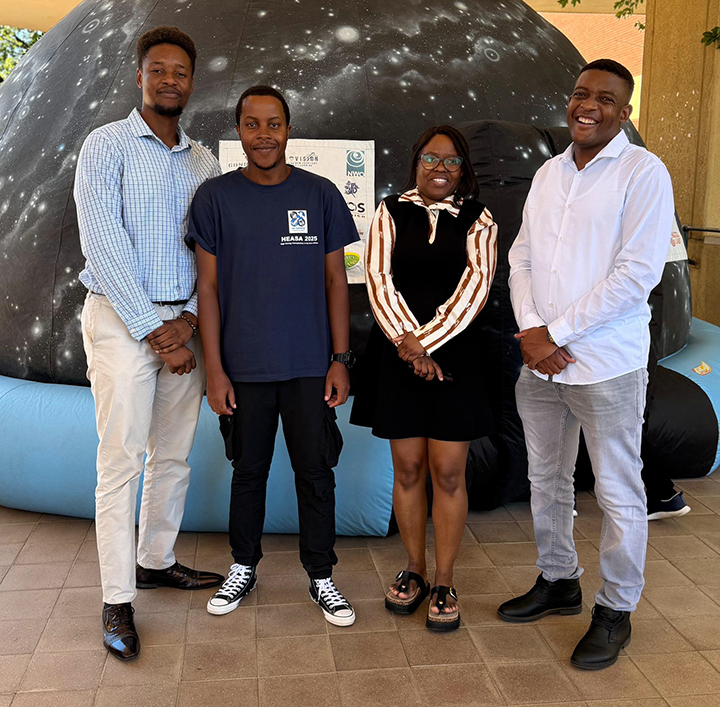
From left, Nhlengani Junior Baloyi, Hiiko Katjaita, Dr Portia Legodi, and Dr Lott Frans (Photo credit: UNAMTV)
The Unisa and UNAM delegations were accompanied by a group of young academics who gained first-hand exposure to the opportunities that await them as part of the AMT project:
- Nhlengani Junior Baloyi is an Astronomy PhD student at Unisa and was recently appointed as an Adjunct Academic in the Department of Mathematical Sciences. “My research broadly focuses on Active Galactic Nuclei (AGNs),” says Balyoi, “which are bright, compact regions found at the centres of some galaxies. The bright light observed in an AGN is produced by a central supermassive black hole consuming the gas and dust surrounding it. By examining the large-scale structures produced by AGNs at radio frequencies, using instruments like the SKA and AMT, my research will hopefully contribute to our understanding of plasma physics and cosmic magnetism.”
Baloyi is enthusiastic about the opportunities offered by projects such as AMT: “Many children in South Africa lack access to good-quality mathematics and science education, let alone information regarding astronomy as a possible career path. As young academics, it is crucial for us to help bridge that gap, inspire the next generation of scientists, and ensure, above all, that knowledge belongs to everyone – not to a select, privileged few.” - Dr Portia Legodi is a radio astronomer and researcher based at the Unisa Centre for Astrophysics and Space Sciences, specialising in high-resolution imaging of radio galaxies. “The expansion into the millimetre regime with the AMT, says Legodi, “is more than a technical step forward. It is a route to answering some of today’s most pressing questions about the evolution of galaxies and active galactic nuclei across cosmic time. My goal remains unchanged from my earliest days in research: to transform the invisible forces of our universe into high-quality imagery and turn those images into the kind of bold science that reshapes our understanding of the cosmos.
- Hiiko Katjaita is a PhD candidate in Astrophysics at the University of Namibia. “My research focuses on preparing for the scientific operations of the AMT,” says Katjaita. “My interest in astronomy stems from a fascination with the unknown and the idea that we are the universe’s way of knowing itself. For me, astronomy is not only about collecting data but also about exploring our origins and asking the profound questions about why we are here.”
Katjaita continues: “My advice to young students in Namibia and across Africa who are interested in science or astronomy is to realise that they belong in this space and that they do not have to leave the continent to do world-class research. With projects like the AMT and the Square Kilometre Array taking place in Africa, the centre of gravity for global research is shifting. If you are curious about the universe, know that your perspective is needed. Start where you are, stay curious, and believe that you can be at the forefront of discovery right here at home.” - Dr Lott Frans is a Postdoctoral Fellow at UNAM and an associate researcher at the Istituto di Radioastronomia, INAF, Italy. “I completed my PhD at the University of Namibia in astrophysics, the very first such doctorate to be produced within Namibia,” says Frans. “My personal interests lie in advancing sciences across Namibia, South Africa, and Africa for self-sustainability as well as in building capacity in STEM fields through outreach. At the moment, one of my priority research contributions is towards the building and realisation of the AMT, which will enable humans to capture black hole movies, the first of their kind.”
Read also:
Unisa and UNAM partnership advances Africa Millimetre Telescope project
* By Nolwazi Mwabi, Director: Communication, Marketing and Events, Department of Institutional Advancement, Unisa
Publish date: 2026-03-05 00:00:00.0