
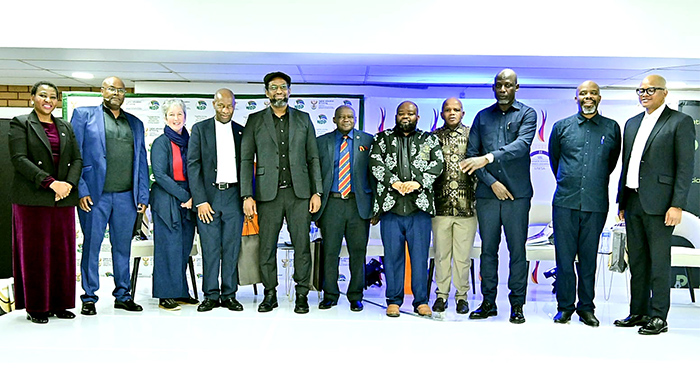
The panel that was part of the discussion
South Africa's post-school education and training (PSET) sector needs more than institutional interventions to address individual crises. It needs a systemic reset that places outcomes, student success and the country’s skills needs at the centre of how the sector is organised.
That was the message from Higher Education and Training Minister Buti Manamela at the Unisa Graduate School of Business Leadership (SBL) Distinction Dialogue, where leaders examined the relationship between governance, public investment and institutional performance.
"Money has to go into outcomes," Manamela told the gathering.
His comments came against the backdrop of the department's 2024/25 performance, when fewer than half of its planned targets were achieved despite the available budget being spent. Manamela stressed that performance figures have consequences beyond government reports and departmental assessments.
A missed target can affect whether a student receives an allowance, completes a programme, receives a qualification or gains access to training that improves their prospects of employment.
The gap between public spending and these outcomes formed the central concern of the dialogue, hosted by Unisa SBL in partnership with the National Press Club and the Department of Higher Education and Training under the theme, "Resetting the PSET Sector: Governance and the Road Beyond Administration."
Delivering the official welcome on behalf of Unisa Principal and Vice-Chancellor Prof Puleng LenkaBula, Dr Azwinndini Tshivhase, Vice Principal for Teaching, Learning, Community Engagement and Student Support, pointed to the difference between having ambitious policies and implementing them effectively.
"We don’t have a shortage of aspirations," Tshivhase said, noting that South Africa already has policies, development frameworks and national ambitions. The challenge, he suggested, is turning those commitments into outcomes that students and communities can experience.
For Manamela, the problems facing the sector are too interconnected to be addressed through isolated interventions.
"The challenges of the sector are systemic, and it is time that we have a reset of the way in which our sector has been organised," he said.
The distinction is important for institutions currently under administration. Interventions can restore controls, address governance failures and stabilise operations. But the longer-term test is whether those improvements remain in place after administrators leave and whether they ultimately improve the experience and prospects of students.
NSFAS provides a clear example of the challenge.
Prof Hlengani Mathebula, NSFAS Administrator, described taking over an organisation facing unreliable systems, serious audit concerns and significant operational weaknesses. His account of the first 100 days, however, focused on restoring attention to the people the organisation exists to support.
"In that 100 days, we have been able to return the students to the centre of focus for the entity," he said.
According to Mathebula, this has included responding more quickly when institutions experience funding and accommodation challenges and improving direct engagement between universities and NSFAS. At Unisa, he said, these interventions have supported the registration of thousands of students.
But Manamela argued that addressing operational failures alone will not resolve the broader challenge facing student funding.
Persistent funding pressures, he said, require government to reconsider the sustainability of the country’s student funding model rather than repeatedly repairing individual problems within NSFAS.
"We need to go to ground zero when it comes to NSFAS, but also when it comes to student funding in our country," he said.
The question therefore extends beyond NSFAS itself: is South Africa's PSET system organised in a way that gives learners clear and meaningful pathways from education into further study, training and employment?
Prof Walter Matli, Executive Dean and CEO of Unisa SBL, called for that wider question to be confronted.
"We need to look at the PSET sector and ask, how can we reconfigure the entire system?" he said.
For many young South Africans, the challenge begins before they enter higher education. Universities and colleges cannot accommodate every school-leaver seeking further study, while learners who enter different parts of the PSET system can encounter qualifications and programmes that do not always provide clear progression towards further study or employment.
Matli's intervention therefore focused on how the different parts of the sector could provide clearer pathways. Universities, TVET colleges, community colleges and SETAs have distinct roles, but a more coherent system would allow learning and training opportunities to connect rather than leaving students with qualifications that do not necessarily lead to the next stage of their development.
The discussion also highlighted the relationship between governance and institutional performance.
Dr Robert Nkuna, Administrator of the College of Cape Town, argued that the two cannot be treated as separate concerns.
"Governance and performance are mutually reinforcing. It is not either or," he said.
That relationship is ultimately measured in practical outcomes. Weak procurement can delay programmes. Poor planning can affect the delivery of training. Governance failures can divert institutional attention and resources away from students. Over time, these problems can also undermine confidence in public institutions.
The dialogue therefore moved beyond the immediate question of how to stabilise institutions experiencing difficulties. The broader issue is whether the PSET sector can operate as a more coherent system in which governance supports delivery, funding reaches students, qualifications provide meaningful progression and skills development is connected more deliberately to employment.
Manamela described this ambition as "a skills revolution for a working South Africa".
Achieving that ambition would require more than repairing institutions after they encounter problems. It would require stronger links between employers, SETAs, universities, TVET colleges and community colleges, as well as clearer pathways from learning into the workplace.
Work-integrated learning, in particular, will need to play a greater role if qualifications are to translate into practical experience and improve graduates' prospects of employment.
The central challenge, then, is not simply whether troubled institutions can be stabilised. It is whether the reforms introduced today can produce institutions that continue to perform tomorrow.
For students, that question is straightforward.
Will funding arrive when it is needed? Will a qualification provide a meaningful pathway into further study or employment? Will training equip learners with skills that employers need? And will public investment produce outcomes that can be seen in the lives of the people the system is designed to serve?
For South Africa's PSET sector, answering those questions will be the real measure of whether the proposed reset succeeds.
* By Thina Gwiliza, Communications and Marketing Specialist, Unisa SBL
* Photographer: Shooheima Champion, Unisa Multimedia
Publish date: 2026-08-25 00:00:00.0
Contact the Marketing and Communication office: Ms Thina Gwiliza at gwilita@unisa.ac.za
011 652 0339
Telephone: +27 11 652 0248 / +27 11 652 0291
Email: sbl@unisa.ac.za
Physical Address:
Cnr Janadel and Alexandra Avenues
Midrand, 1686
Gauteng, South Africa
Download map & directions (PDF)